The Race Is on to Set the Narrative About the WHCD Shooting
Written by Jim Geraghty
Share this story
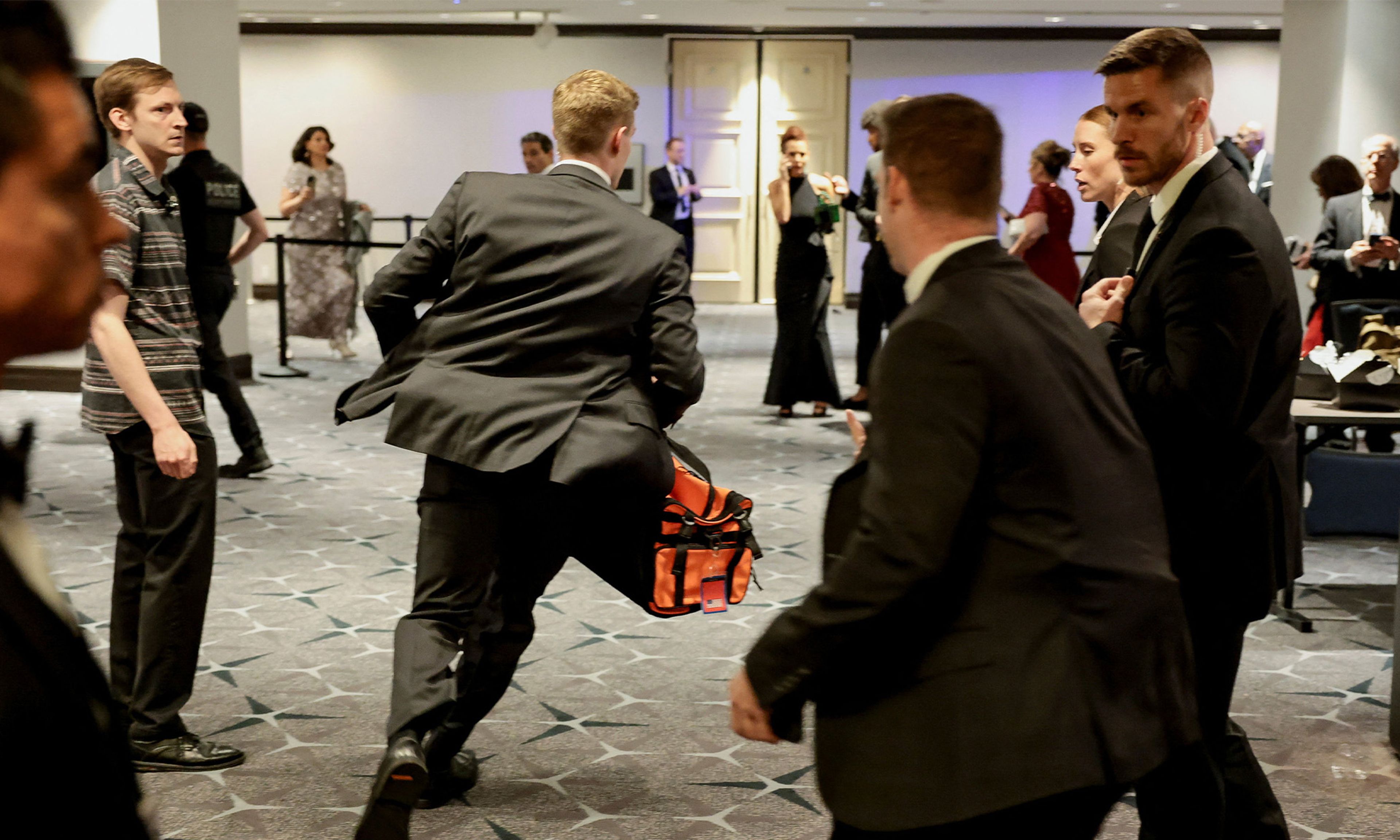
On the menu today: The first moments and hours after a dramatic event like the shooting at the White House Correspondents’ Dinner have turned into a competitive sprint among political activists to promote a narrative most useful to their cause, regardless of the facts. And it is not just random users of social media who are playing this game. Read on.
Shifting the Story
When something dramatic and surprising happens, like a shooting at the White House Correspondents’ Dinner, everyone wants to know more. But getting the basic facts — the name of the shooter, his background, the sequence of events, anyone who was injured, and so on — takes time. The first information is often wrong; CNN’s Kaitlan Collins reported minutes after the shooting that a member of the U.S. Secret Service told her that the assailant had been shot dead.
(That’s not intended as a criticism of Collins; if you’re a CNN correspondent and you hear news like that from a seemingly reliable source like a U.S. Secret Service agent, should you withhold that from your viewers? We just went through a controversy where many journalists “knew” about the awful behavior of former Representative Eric Swalwell, but no one reported on it because they didn’t have a source willing to go on the record.)
Nature abhors a vacuum, and so do activists on social media. When the facts are unknown, activists will craft their own preferred narrative, making up the facts that they would prefer to see, and attempt to spread it far and wide.
At 8:22 a.m. Sunday morning, “activist, feminist and author” Amy Siskind informed her 447,000 or so followers on X that the shooter was “not politically affiliated” and declared that it was not yet clear if Trump was the target:
The shooter from last night was a CalTech grad who had just got his graduate degree in computer science. He was staying at the hotel. The shooting happened the floor above the ballroom. Despite Trump trying to use this to push forward his ballroom project, it’s unclear if Trump was even the target! He was not politically affiliated.
Now, if you’ve paid attention to the news since Sunday morning, you know both of her assertions are nonsense. The shooter was indeed quite outspoken in his political views. In his manifesto that he sent to family members shortly before his attempted attack, he wrote, “I am no longer willing to permit a pedophile, rapist, and traitor to coat my hands with his crimes. . . . I’m not the person raped in a detention camp. I’m not the fisherman executed without trial. I’m not a schoolkid blown up or a child starved or a teenage girl abused by the many criminals in this administration.” He posted more than a thousand times on the social media site BlueSky, used almost exclusively by progressives, denouncing the president and his administration.
As for Siskind’s claim, “it’s unclear if Trump was even the target,” it is theoretically possible for a person to carry a gun and charge past a metal detector and U.S. Secret Service agents into a room where the president and a lot of administration officials are, with no intention to harm the president. But at some point, Occam’s razor kicks in. If you were planning on committing a murder of anyone other than the president, then grabbing a gun and charging into a room with the president, with a lot of television cameras, witnesses, and armed Secret Service agents trained to shoot on sight is probably just about the worst possible place in the world to attempt to commit that murder.
There is a strong incentive to put out a false narrative as fast as possible; “anchoring bias” is a cognitive bias that causes us to rely heavily on the first piece of information we are given about a topic. If you put out the narrative that the shooter was an apolitical nut, with no animus toward the president or his party, some people will then doubt the subsequent official account, even if it comes with supporting information like the shooter’s manifesto or BlueSky posts or other eyewitness testimony.
Even if the false narrative never gets widely accepted, the activist can succeed in making the accurate narrative “contested” or “disputed,” and create a sense that what happened was murky and hard to discern. And it’s a safe bet that some percentage of the public will remember — or choose to remember — the false narrative.
Back in 2022, a news website called The 19th wrote a 2,200-word article about the 2016 Pulse nightclub shooting and its legacy as “the most deadly LGBTQ+ massacre in U.S. history.” The article mentioned Florida’s Parental Rights in Education Bill, or so-called “Don’t Say Gay” bill, nine times.
The words “ISIS,” “terrorism,” “Omar Mateen,” “Islam,” and “Islamist” do not appear in the article.
During the Pulse nightclub mass shooting, the perpetrator, Omar Mateen, called 911 and declared, “I pledge of allegiance to Abu Bakr al-Baghdadi of the Islamic State.” The shooting was indeed the largest massacre of gay and lesbian Americans in U.S. history, and that is an indisputable aspect of the story. But there is no evidence that Mateen deliberately targeted gays and lesbians; he simply wanted to target Americans, and the Pulse nightclub looked like an easy target after he had checked out Disney World and concluded it had too much security. There was no evidence Mateen was a closeted gay man or hated himself for being gay, and no claim that Mateen had visited the club before the shooting checked out.
Mateen’s motivation was indisputably Islamist terrorism, but the article in The 19th saw no reason to even mention that part of the story. (They write, “At The 19th, we believe you can’t fully understand politics, policy or power without looking through the lens of gender and race.” But apparently religious extremism, not so much.)
People might ask why it matters that progressives chose to remember the Pulse nightclub attack as driven by the shooter’s homophobia, rather than his Islamist beliefs and support of ISIS, at a moment like this. You probably recall who was president in 2016.
At 5:15 p.m. on Sunday — well after a great many details about the shooter and his worldview had been reported — former President Barack Obama posted on social media:
Although we don’t yet have the details about the motives behind last night's shooting at the White House Correspondents Dinner, it’s incumbent upon all us to reject the idea that violence has any place in our democracy. It’s also a sobering reminder of the courage and sacrifice that U.S. Secret Service Agents show every day. I’m grateful to them — and thankful that the agent who was shot is going to be okay.
While much of that message is a noble sentiment, it is notable that almost a full day later, Barack Obama is erroneously telling his 119 million followers on X that the motives of the gunman are unclear. And even before the discovery of the manifesto or the assailant’s social media posts, when a guy with a gun charges past security into a room holding the president and many of his cabinet members, figuring out the motive is not exactly akin to cracking the Riemann hypothesis.
There are some progressive activists who absolutely need to believe that other progressive activists do not commit acts of political violence. (You may want to send them Noah’s book.) Heather Cox Richardson, reportedly the most popular writer on Substack, wrote back on September 13, 2025, that regarding the murder of Charlie Kirk, “the alleged shooter was not someone on the left. The alleged killer, Tyler Robinson, is a young white man from a Republican, gun-enthusiast family, who appears to have embraced the far right, disliking Kirk for being insufficiently radical.” That is patently, absurdly false, in contradiction to the shooter’s own messages to his roommate and lover. Richardson has never corrected that claim, nor even acknowledged the complaints that she is spreading falsehoods.
Richardson teaches 19th-century American history at Boston College. If you change the way people remember history, is that a way of changing history?
A little while ago, in that other Washington publication, I wrote about the trend of bigger and more lavish presidential libraries. Back in 2014, law professor Josh Blackman visited Bill Clinton’s presidential library and noted its . . . curious treatment of Clinton’s most infamous scandal:
The other interesting element of the museum was how they covered the impeachment and the Lewinsky affair. As you may expect, the entire impeachment was spun as a political vendetta by Newt and the right-wing conspiracy. Entirely lacking was *any* discussion of why they sought to impeach him. Monica’s name was mentioned twice, and it referenced a “relationship” with the President. That’s it. No details about sex. I understand this is the President’s museum, but it is still operated by the National Archives and I would hope they would hold some slightly higher standards.
Right now, in our discourse, we are witnessing and participating in a battle that will determine how this attempted attack on the White House Correspondents’ Dinner is remembered.
The New York Times reported that on Sunday, “more than 359,000 posts appeared on X using the keyword ‘staged,’ part of a surge of conspiracy theories claiming that attacks on President Trump were not genuine.”
Sunday afternoon, Yashar Ali wrote, “If you say that something is fake, a false flag, a setup, a hoax, a psyop, or staged before you have gathered any evidence and had a chance to analyze it, you’re radicalized, and that radicalization is impacting your ability to assess reality.”
Unfortunately, a disturbingly high number of people participating in our political discourse are indeed radicalized, to the point where they say things like “America deserved 9/11,” or “It doesn’t matter if rape happened on October 7th,” or “let the streets soak in their red-capitalist blood.” (Oh, wait, that was all the same guy, featured in the New York Times on a regular basis.)
If you put a flattering photo of a terrorist bomber on the cover of Rolling Stone, do you think you get more bombers, or fewer bombers?
If an unhinged talking head declares that assassin Luigi Mangione is “a morally good man” as the CNN correspondent nods along, do you think you get more or fewer aspiring assassins?
ADDENDUM: So, how about that new slogan of House Minority Leader Hakeem Jeffries and the House Democrats, “Maximum warfare, everywhere, all the time”?
You know, fellas, you could have said “maximum opposition” or “maximum defiance” and not found yourselves in this mess. But no, you had to choose the word “warfare.”
Ironically, most House Democrats believe in fighting “maximum warfare” against the president and their congressional opponents, but not against the Iranian regime.

About the Author
Jim Geraghty is the senior political correspondent of National Review.
Featured Tags
Advertisement
Advertisement
Comments