Tariffs Are a Tax on Americans No Matter What the White House Says
Written by Veronique de Rugy
Share this story
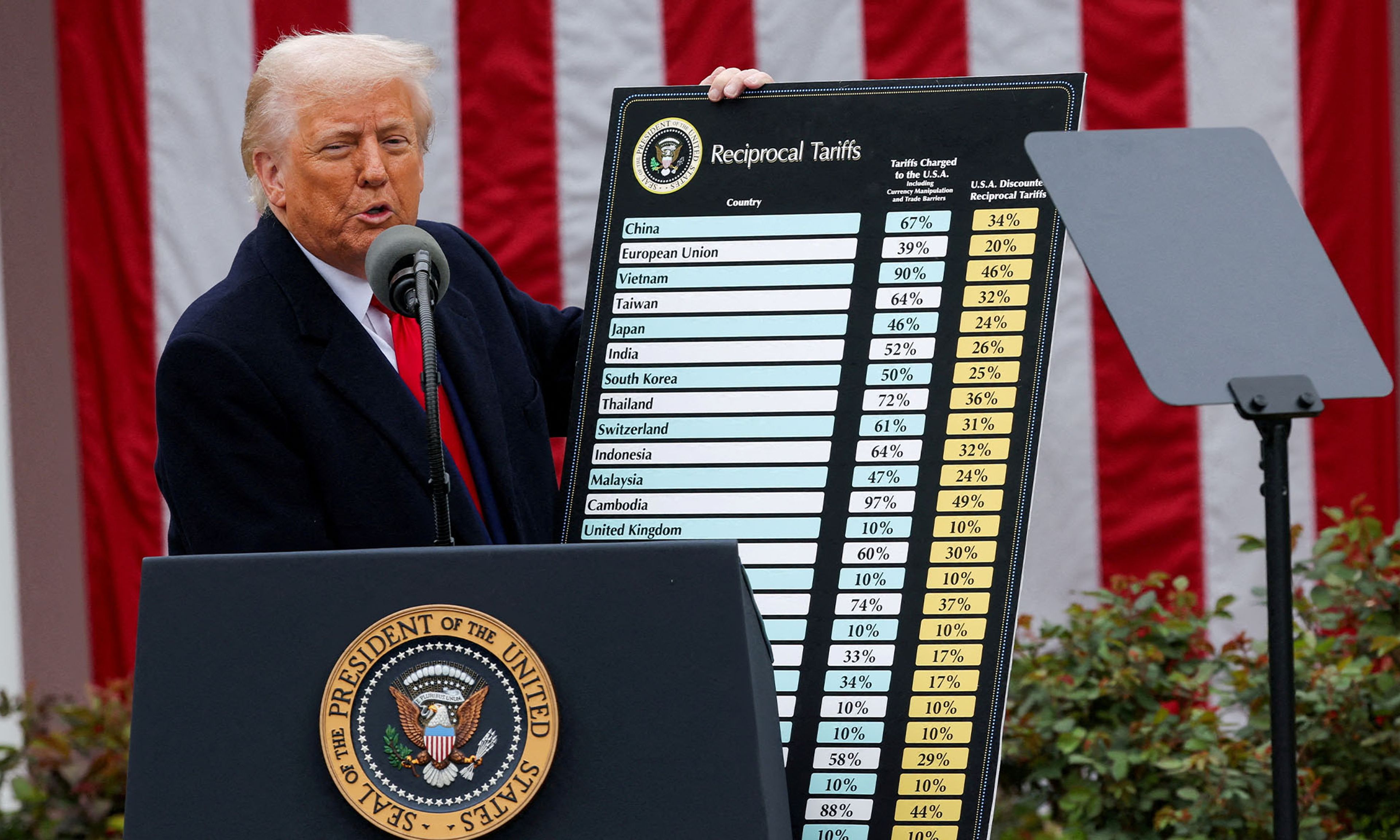
The Trump administration has both a tariff problem and an economic reasoning problem.
Recently, two senior officials have pushed back against a New York Fed study confirming the findings of other studies showing that American businesses and consumers paid for almost all of the 2025 tariffs with claims about tariffs that don't withstand scrutiny. Director of the National Economic Council's Kevin Hassett argued that tariffs make U.S. consumers better off by bringing production home and raising wages. Trade representative Jamieson Greer insisted that tariffs aren't regressive because "most consumption in America is done by the wealthiest people."
Both claims are not merely wrong, but wildly so. And understanding exactly why they're wrong matters, because bad economic thinking leads to bad policy that real people pay for. So here it is.
According to Hassett, if, because of tariffs, "we bring the stuff home, create the demand at home, then that will hurt China and drive up wages of the U.S., and American consumers will be better off."
It sounds intuitive: Slap tariffs on foreign goods, companies move production back to America, workers get hired, wages rise, everyone's better off.
Here's the problem: Tariffs don't create demand. Demand already exists. What tariffs do is shift where goods are produced, moving output from lower-cost foreign producers to higher-cost domestic ones. That's a subsidy to certain industries, paid for by everyone else in the form of higher prices -- higher prices both for protected goods as well as for goods produced by other domestic industries that lose resources and workers to the protected industries.
Yes, wages might rise in protected sectors. But higher wages in steel are paid at the expense of a family buying a washing machine that now costs $100 more. That $100 would have also been spent somewhere else and that somewhere else is now short $100. Your real wage, what your paycheck actually buys, is your purchasing power. When tariffs raise prices on many different goods, your and most other Americans’ purchasing power falls.
And what about the idea that "hurting China" automatically makes Americans richer? That's not how trade works. Trade isn't a zero-sum sporting event. When Americans buy fewer goods from China, they lose access to cheaper products and inputs. China does lose export revenue, but American consumers and businesses also lose. Economic welfare isn't determined by whether a rival suffers; it's determined by whether you're better off. That said, there are legitimate cases where tariffs can shift bargaining power or protect industries with long-term strategic value. But even proponents of those arguments generally concede there's a real cost to American consumers; they just argue the strategic benefit is worth it. The key distinction is between accepting that trade-off honestly and claiming that hurting a rival is itself a win for America. It isn't.
Now Greer’s claim: "It's not regressive. Most consumption in America is done by the wealthiest people. So the idea it's somehow regressive is just wrong."
This gets regressivity exactly backwards.
Regressivity isn't about how many absolute dollars you spend compared to how many absolute dollars other people spend. It's about the percentage of your income that you spend compared to the percentage spent by other people. Lower-income households spend on consumption nearly everything they earn, with a large share of that going toward clothing, appliances, and basic household goods, many of which are import-intensive. Wealthier households save a much larger fraction of their income, shielding them from consumption-based taxes.
So even if billionaires fork over more dollars at the checkout counter than poor families do, tariffs still consume a far smaller slice of the household income of billionaires than they consume of the incomes of poor families. That is the meaning of a regressive tax. Empirical research on the 2018–2019 tariffs confirmed exactly this: Import prices rose, most of the cost passed through to U.S. consumers, and the burden fell disproportionately on lower- and middle-income households as a share of income.
To be fair, many other commentators, not just White House staff, had really confusing things to say about the tariff study.
Writing in response to the New York Fed study, Batya Ungar-Sargon wrote on X:
The article posted to the New York Federal Reserve’s website doesn’t even claim to show that “you’re paying” the tariffs. It claims to show that based on who paid the import duty of the tariffs, “nearly 90 percent of the tariffs’ economic burden fell on U.S. firms and consumers."
Did you catch that? The tariffs are being paid by you — the consumer — and “U.S. firms.” So, you and Walmart. You and Target. You and Nike. You and Amazon. . . .
She argues that the question isn't whether the burden stayed in the U.S.; instead, it's how it breaks down within the U.S. Did these massive corporations absorb the cost in lower profits? Or did they pass it on to you in the checkout aisle? If it's the latter, that's bad for working families. If it's the former, if trillion-dollar corporations quietly ate the cost, then who cares. Or so argues Ungar-Sargon.
Ungar-Sargon thinks that she identifies a critical flaw in the study: "Note the slippage: The New York Fed just assumes that the companies passed on that extra cost to you, without actually proving it — then acts like they have proven it."
It's a clever rhetorical move. And it would be compelling if the Fed had actually just assumed pass-through without measuring it. But that's not what happened. The Fed researchers weren't working from a theoretical model that presupposes firms pass costs along. They used detailed transaction-level import price data to track what happened to prices after tariffs were implemented, comparing affected goods to unaffected ones, and U.S. import prices to foreign export prices. What they found was concrete: Import prices — what U.S. importers paid at the border — rose nearly one-for-one with tariff rates. Foreign exporters did not systematically cut their pre-tariff prices to offset the duties. The cost landed squarely on U.S. importers. What happens next, whether importers passed that cost along to consumers or absorbed it in lower profits, is a separate question, addressed in a companion study, which found, using survey evidence, that businesses did largely pass the costs on.
There's also a basic economics point lurking here. The argument that large corporations might simply absorb the cost sounds plausible, but it misunderstands how competitive markets work. When retailers face sustained cost increases, their options are limited: Raise prices, accept lower margins, cut costs elsewhere (often wages or investment), or some mix of all three. Even when firms absorb part of the tariff in lower profits, that cost doesn't vanish into thin air. It shows up as lower returns to shareholders. These lower returns result in slower investment, reduced hiring, lower wages, and, importantly, less output and higher prices down the road. In the long run, in competitive retail markets with thin margins, sustained cost increases don't stay buried in profits. They result in contractions in operations and higher prices.
The deeper issue is that the argument conflates two very different things: legal incidence (who writes the check to Customs) and economic incidence (who ultimately bears the burden of tariffs). This distinction is Economics 101. When Congress imposes a payroll tax on employers, that doesn't mean employers bear the full economic burden. Depending on labor-market conditions, workers absorb much of it through lower wages. The same logic applies to tariffs. Who remits the tariffs tells you nothing definitive about who ultimately pays them.
So yes, "you and Walmart" both show up in the data. But the evidence shows that Walmart, like most retailers, passed the cost along one way or another.
Finally, this is anecdotal, but here is what I received when I ordered some $433 of stuff from France recently. Looks to me like I paid the tariff, and it was close to 50 percent.

About the Author
Veronique de Rugy is a senior research fellow at the Mercatus Center at George Mason University.
Featured Tags
Advertisement
Advertisement
Comments