What the Founders Understood About Faith and Freedom
Written by Andrea Picciotti-Bayer
Faith is not an intruder in public life; it’s a part of our civic DNA.
Share this story
Each December, my children and I hang lights on our house and set up a big Nativity scene in our front yard. Like many Americans, we feel comfortable expressing our faith in public. The Founders recognized this reality as well. They understood that freedom of religion should not just be permitted, but that it was essential to a flourishing society and provided a moral foundation for self-governance.
Yet for decades, courts have treated public expressions of faith with suspicion, even hostility, as if the Constitution demands that religion be hidden away. Thankfully, the U.S. Supreme Court has begun correcting this error, restoring an understanding of religious freedom more faithful to the First Amendment’s design.
As a civil rights lawyer focused on religious liberty, I am watching closely two cases moving through the courts that will test whether this course correction endures — whether the robust protection of religious freedom secured by the Constitution’s religion clauses will be consistently applied.
The Founders never envisioned scrubbing religious influence from public life. Even Thomas Jefferson — whose 1802 letter to the Danbury Baptists gave us the now-famous phrase “wall of separation between church and state” — was no strict separationist. As president, he attended religious services held in the House of Representatives and signed legislation allocating federal funds for a Catholic priest to minister to the Kaskaskia Indians.
Across the founding generation, religious expression in civic life was routine: Congress opened its sessions with prayer, presidents issued Thanksgiving proclamations, and George Washington cautioned in his Farewell Address that “reason and experience both forbid us to expect that national morality can prevail in exclusion of religious principle.” Far from seeking to banish faith from public life, the Founders regarded religion as a stabilizing and essential force for the republic.
Beginning with the Supreme Court’s Lemon v. Kurtzman decision in 1971, courts applied a three-pronged “Lemon test” to evaluate whether government action constituted an unlawful establishment of religion. In practice, this test created a presumption of hostility toward religious expression in public settings, and it departed dramatically from our nation’s founding principles.
In 2022, the Supreme Court changed direction. In Kennedy v. Bremerton School District, the Court threw out the Lemon test and its progeny when it vindicated a high school football coach who was fired for his brief, personal prayers on the field. The message was clear: The Constitution doesn’t require hostility toward religion. It forbids the government from establishing an official church or coercing religious observance. It doesn’t ban every religious expression from public view.
Now comes the test of whether courts will apply this principle consistently.
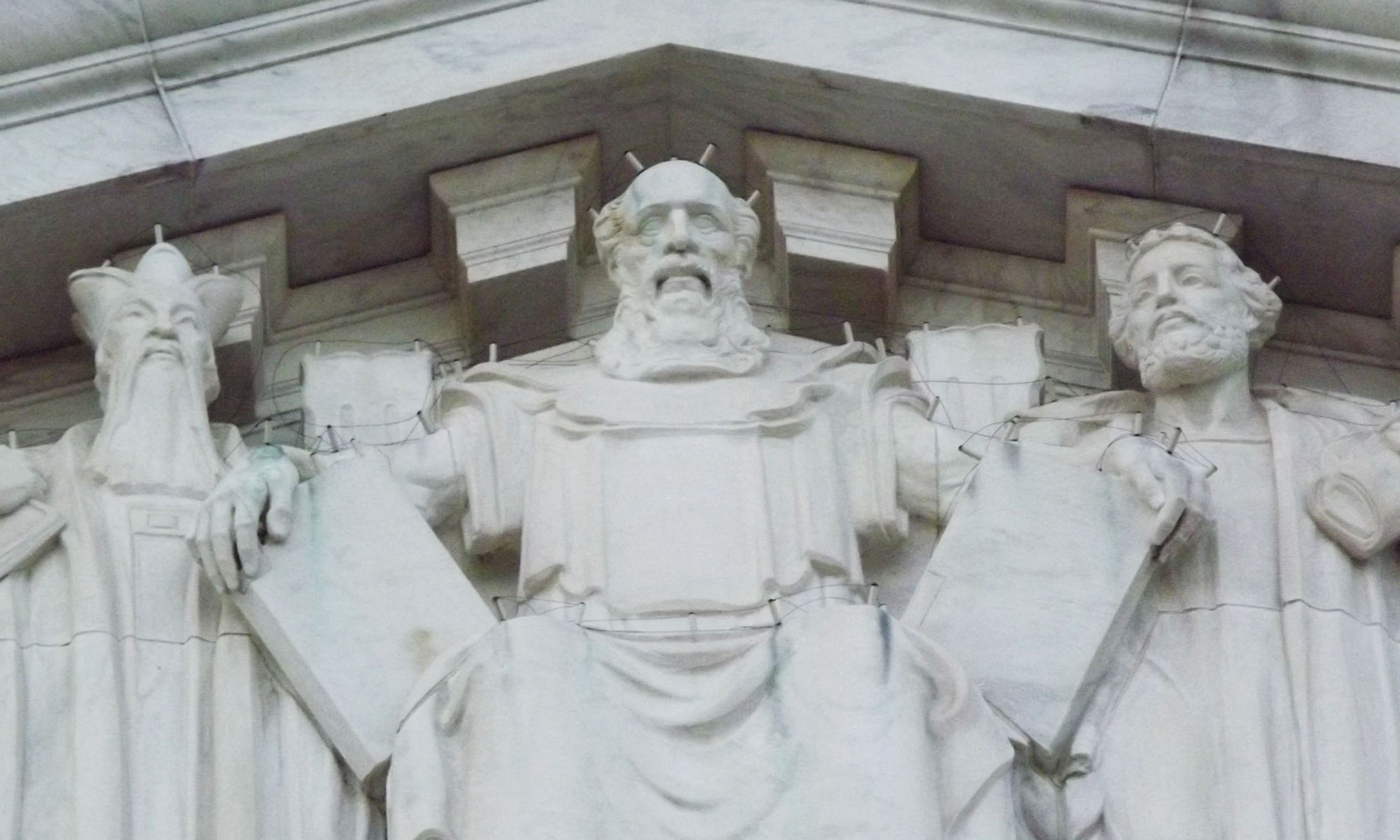
Louisiana and Texas have recently passed laws requiring the Ten Commandments to be displayed in public school classrooms. Critics who contend that this violates the Establishment Clause of the Constitution are wrong. No one is being forced to recite them. No one is being compelled to worship. They simply exist as part of our historical and moral heritage — the same heritage reflected in the Supreme Court building itself, where Moses is depicted on the South Wall Frieze holding two tablets, written in Hebrew, representing the Ten Commandments.
Consider the contrast with Mahmoud v. Taylor, a case the Supreme Court addressed last term. There, Montgomery County, Md., public schools required elementary students to receive instruction using "LGBT-inclusive" storybooks that promoted same-sex marriage and gender ideology, with no opt-out for families whose religious beliefs conflicted with this curriculum. The Court found that refusing to accommodate these parents’ religious objections violated their free exercise rights.
The difference is coercion. In Mahmoud, the school district mandated that children participate in instruction that contradicted their families’ religious teachings. In the case of the Ten Commandments displays, no student is required to read them, affirm them, or incorporate them into their beliefs.
States are free to choose not to post the Ten Commandments in their public schools. But that choice is a matter of policy preference, not constitutional mandate. To treat a foundational historical text with religious significance as constitutionally toxic, while permitting countless other political or anti-religious messages in schools, suggests the problem isn’t neutrality but religious discrimination.
This January, the full Fifth Circuit Court of Appeals will consider challenges to these laws in a combined appeal. The question before them is profound: Will they embrace the Supreme Court's new direction, recognizing that displays with deep historical roots and no coercive element are perfectly constitutional? Or will they retreat to old, discredited reasoning like that in Stone v. Graham, a 1980 case that used the faulty Lemon test to declare displays of the Ten Commandments in Kentucky classrooms unconstitutional?
In the second case I’m keeping a close eye on, St. Mary Catholic Parish v. Roy, the Supreme Court also has a chance to correct a rule that has haunted religious Americans. In 1990, Associate Justice Antonin Scalia authored Employment Division v. Smith, arguing that if a law is “neutral” and “generally applicable,” it can burden religious exercise without any special justification. This has encouraged progressives in the state of Colorado, for example, to weaponize seemingly neutral policies prohibiting “discrimination” based on sexual orientation and gender identity to exclude individuals or organizations with traditional religious views on marriage, human sexuality, and identity from participating in government-run programs.
In St. Mary’s, Catholic parishes in Colorado want to participate in the state’s universal preschool program, but only if they can maintain their religious mission, including traditional teachings on human sexuality and identity in their admissions policies. Colorado says no: Participate on our terms or not at all.
States are free not to offer programs like universal preschool. But if they do, they cannot exclude faith-based schools by invoking expanded anti-discrimination laws in the absence of any compelling interest. Here, Colorado’s generalized interest in “inclusivity” is mismatched to the state’s actual interest: offering Colorado families financial help to access preschool education. The parishes have asked the Supreme Court to hear their case. They are arguing for a return to genuine religious liberty: the principle that government needs a compelling reason before it forces people to choose between their faith and participation in civic life.
Both the Ten Commandments case and the Colorado preschool case illustrate the same essential truth: Faith is not an intruder in American public life. It is part of our civic DNA.
A victory for religious freedom in both cases will affirm what our Christmas displays already demonstrate: that faith is part of the fabric of American society. The Founders did not design the Constitution to pretend that we are a faithless people, but to ensure that we remain a free one.

About the Author
Andrea Picciotti-Bayer is director of the Conscience Project and recipient of the Religious Freedom Institute’s 2025 Religious Freedom Impact Award.
Featured Tags
Advertisement
Advertisement
Comments