We Should Not Kick Catholic Priests out of the U.S.
Written by Dan McLaughlin
Congress should build upon Trump administration reforms to help American Catholics.
Share this story
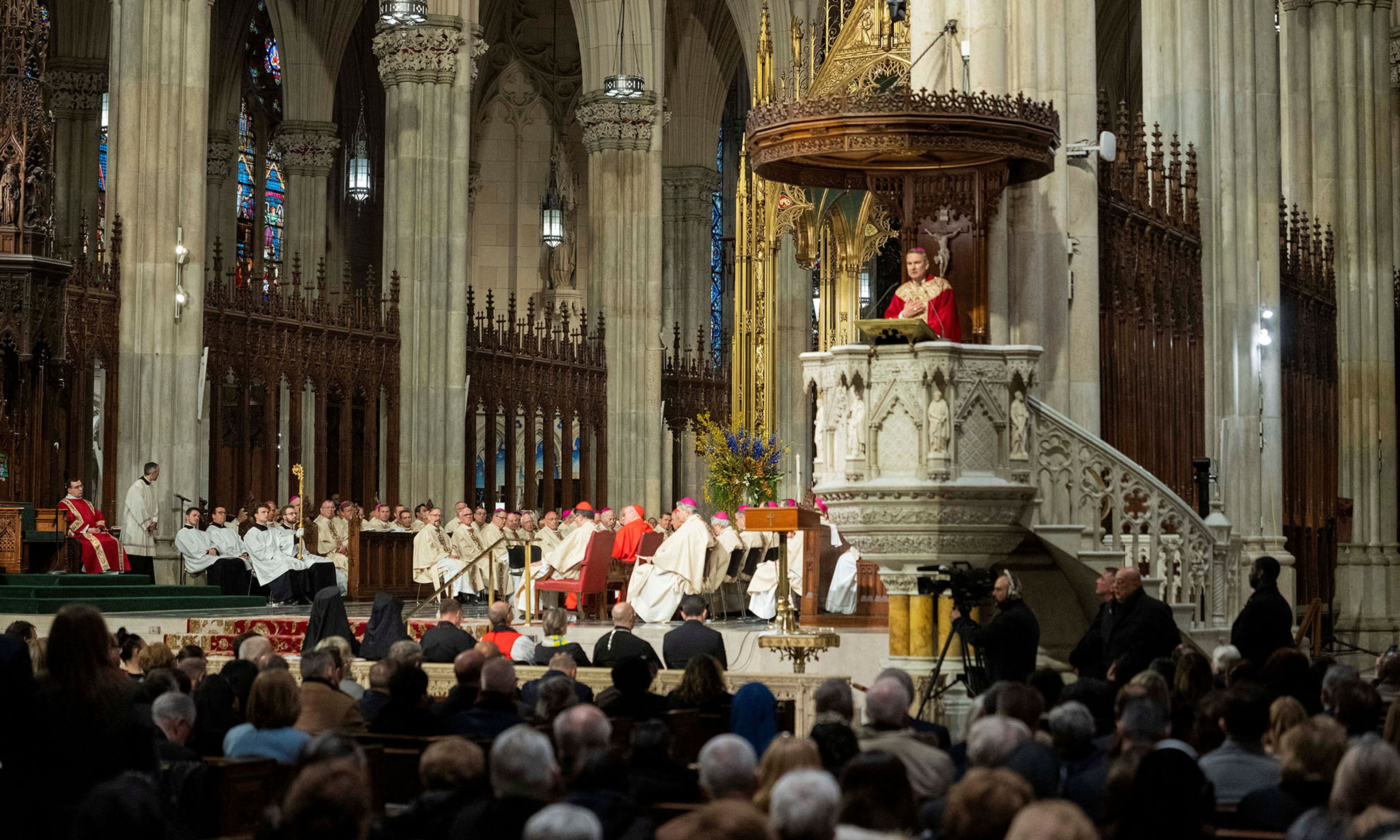
The American Catholic Church has, for quite a few years now, faced a shortage of priests to serve its parishes. Mercifully, there are still places around the world that produce enough vocations to spare priests who can come to the United States, either for a period of years or permanently. Some of those places are in Europe, such as Poland; many others are in Africa, Asia, the Caribbean, and Latin America. We may think of the First World as sending missionaries to the Third World, but in the 21st century, it’s the Third World that sends Christian missionaries to us.
But there’s a problem: federal immigration law. There are many sound reasons for our laws to control who enters the country and on what conditions. But those laws are written principally to address very different situations than those of Catholic priests. While the law makes some accommodations, and while the Trump administration has recently enacted rules to alleviate some of the problems, this is still a dilemma that Congress could solve -- if it wanted to. This is, however, a difficult moment politically, and one exacerbated by the recent war of words between the president and the pope.
The crisis is significant. As Nick Tomaino warned last year for the Wall Street Journal, “Of the 356 active archdiocesan and extern priests in New York . . . 183 are foreign nationals. The U.S. bishops’ conference recently took stock: With responses from 70% of dioceses and eparchies, it learned that 90% rely on foreign-born religious workers.”
The main mechanism for priests and other religious workers to enter the United States from abroad is the R-1 visa. The path to a green card and citizenship is narrower, with hard numerical limits on the EB-4 visas that pursue a green card. Within those limits, priests compete for places with many other types of immigrants. Moreover, backlogs are so lengthy that priests seeking a green card may have to wait as long as 20 years. Even for those priests who would prefer to settle permanently in the U.S., therefore, the R-1 visa is the church’s best way to get them into the country to fill immediate needs.
That visa is good for five years. That would be fine if priests were low-skilled seasonal workers drawn from a large pool and easily rotated, but they are quite the opposite: men requiring years of training, hard to replace, who are most valuable to American parishes once they have been here a few years, improved their facility with the language and American culture, and built relationships with parishioners.
That would not be a big deal if the visa was easily renewed. But based in part on frameworks from other immigration situations, the immigration agencies have for years required priests to leave the country to reapply -- and to stay out of the country for an entire year. As Tomaino noted, the requirement to leave their parishes was slated in 2025 to hit a quarter of the priests in the Archdiocese of New York. That means that the priest who leaves needs to be replaced by the diocese that brought him here, and the time out of the country is long enough that priests need to find a suitable placement back home (or in a third country) in the interim. It’s not hard to see how disruptive that is for parish life both here and abroad, to say nothing of the management headache it creates for bishops, some of whom have given up dealing with the hassle even at the cost of having fewer priests. And that’s before even considering the substantial delays that can arise in processing renewal applications.
The New Interim Final Rule
The church has argued that staying out of the country for a year isn’t even required by the relevant statutes. The Trump administration came around to agree and issued an immediately effective Interim Final Rule in mid-January that removed any minimum time period to be out of the U.S. The comment period on the rule closed on March 17.
Under the new rule, there’s no minimum time period that priests need to stay out of the country in order to renew their R-1 visas, although they still cannot return until the visa is renewed. It also gives more leeway for the church and other religious employers to file visa renewal petitions in advance, with the aim of getting earlier renewals. The rule cites as policy authority (in addition to its legal analysis of the statute) Trump’s executive order to agencies to strengthen faith-based organizations. Whether the rule is repealed by future Democratic administrations will be a test of whether that party’s growing hostility to the Catholic Church -- and its allergy to anything done by Trump -- outweighs its pro-immigration posture and the needs of the many Catholic Democrats still in office and in the party’s voting coalition.
Problems remain. The Trump administration’s ever-expanding list of countries with travel bans means that the countries from which priests can come to America is constricted -- not stopped entirely, but for example, priests from Nigeria (a country with a huge Catholic population as well as a huge Muslim population) can come here for only a few months at a time. That’s prohibitive.
Legislative Solutions
Proposed bipartisan legislation, the Religious Workforce Protection Act, would address one angle of the problem by allowing priests and other religious workers with pending green-card applications to stay on their R-1 visas beyond five years. The bill’s sponsors include Jim Risch (R, Idaho), Susan Collins (R., Maine), and Tim Kaine (D., Va.) in the Senate and Mike Carey (R., Ohio) and Richard Neal (D., Mass.) in the House.
That’s progress. It would preserve the initial border-control mechanism (the need to be approved for an R-1 visa) and limit long-term stays to those priests who plan to seek long-term legal residence through the green-card process. At the same time, it wouldn’t require green-card applicants to potentially wait decades to get into the country.
In general, priests present an extremely low risk for the problems that typically arise from uncontrolled immigration. They aren’t taking American jobs -- the whole point of bringing foreign priests to this country is that we have more demand for priests than we have domestic supply. They aren’t going to be unemployed or living on poverty-level wages that cause them to demand a lot of social services. They don’t have dependents. They’re not a risk for terrorism. The crime rate among priests is very low and not affected by bringing foreign priests to our shores.
Given their ties to an ancient church with more than 50 million members in the United States, there is no serious problem of cultural assimilation. Their jobs require them to speak or learn English and engage with their local community. Indeed, while some parishes import priests who can connect with a local ethnic community, a great many foreign priests serve parishes where few of the people in the pews look or sound like them. The hierarchical nature of the church curbs the extent to which priests can preach radical doctrines.
It’s cheap and easy to say that the church should just develop homegrown priests. There’s no lack of incentive or effort to do that; but there just aren’t enough recruits, they take years to train, and meanwhile, the cohort of priests at or near retirement age is far larger than the cohort of new priests. And while other religious orders and civilian workers play important roles in the church, priests are truly irreplaceable: Without one, the Mass and other sacraments simply cannot be performed.
The politics, however, are complicated. There are too few Republicans in the Senate to pass party-line legislation of any kind, and little mood on Capitol Hill right now for bipartisan legislation of any kind. The parties have never been further apart on immigration in particular; it is almost certain that any bill with a chance for passage would swiftly be encumbered by demands to defund ICE, require national voter ID, or otherwise attach partisan poison pills. The church has criticized Donald Trump on immigration, and he’s been in an open feud with the pope over the war in Iran, so goodwill is running low.
Progressives, for their part, are still determined for largely pretextual reasons to beat the church over the head with the sex-abuse scandal that erupted into public view in 2002. But it’s been over two decades, the church has greatly overhauled its procedures for dealing with sex abusers, and we have had torrents of evidence in the intervening years showing that systemic failures in dealing with sexual predators have been the rule rather than the exception in the major institutions of our society -- secular and religious, public and private, right and left. After the Me Too era and the Epstein files, it seems quaint and ill-informed to paint this particular social ill as one unique to the Catholic Church.
Moreover, this is one of those cases in which our commitment to religious neutrality makes it very hard to reconcile the law with reality. Many of the problems we don’t face with Catholic priests are very real problems with imported Muslim clerics, as should be clear from past terrorism prosecutions. Members of Congress may feel that they need to punish Catholics for the sins of an entirely different faith because the law must be blind. But if the R-1 visa vetting process still must treat different cases the same, that is no reason to decline the modest reforms of the Religious Workforce Protection Act toward clergy who have already passed through that process.
It’s occasionally a good idea for government and law to make things better rather than worse. The Trump administration deserves credit for liberalizing the R-1 visa renewal process. The Religious Workforce Protection Act would improve on that good work.

About the Author
Dan McLaughlin is a senior writer at National Review Online and a fellow at National Review Institute.
Featured Tags
Advertisement
Advertisement
Comments