Share this story
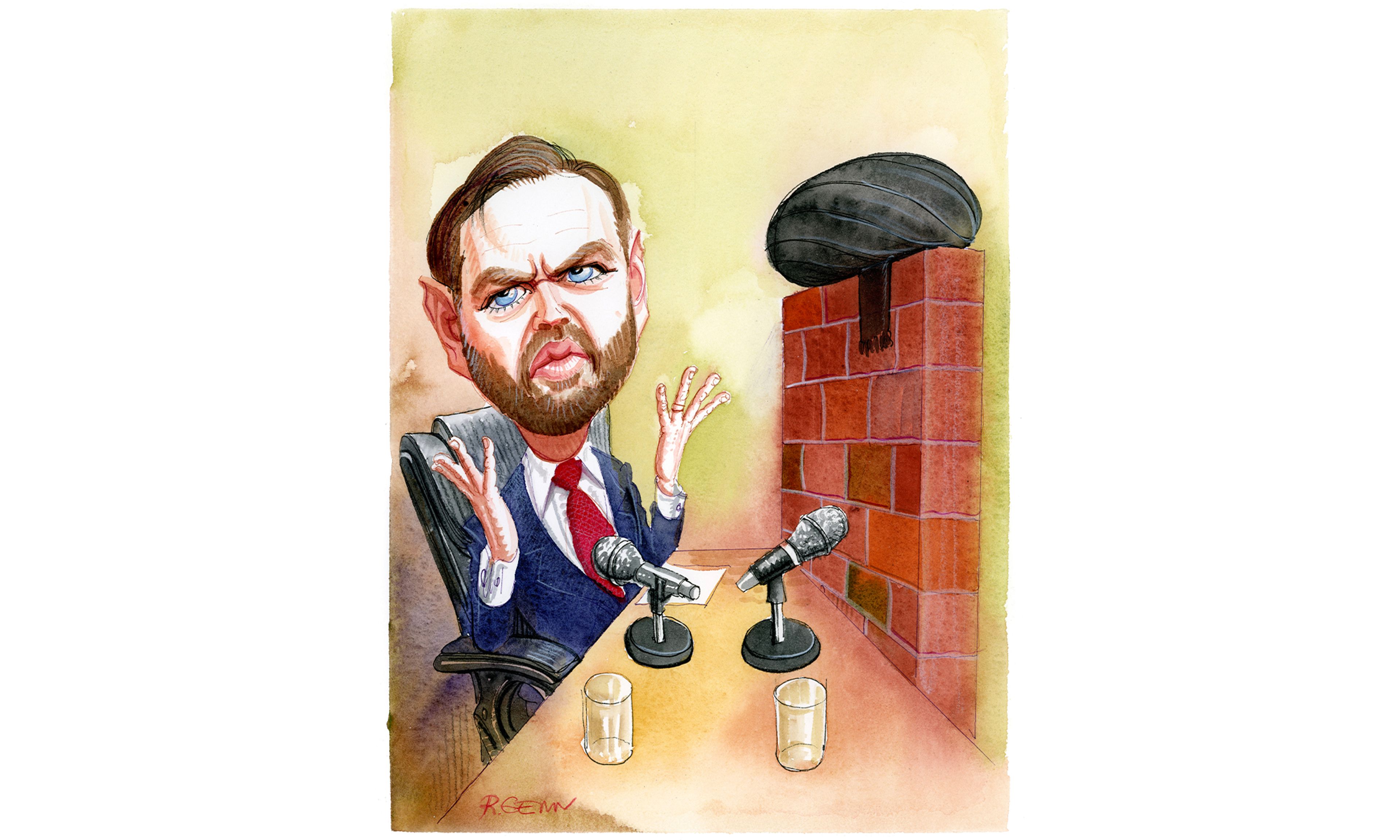
• The difference is the pope claims infallibility only rarely.
• President Donald Trump and members of his administration have picked a fight with the pope. This is unwise and unnecessary. The president was stung by the Holy Father’s criticisms of the war in Iran and is angry at his stance on immigration. There have been conflicting accounts of a testy meeting between Trump officials and the papal nuncio, which reportedly included menacing references to an Avignon-style schism. Whatever really happened has been overshadowed by Trump’s public rhetoric. In a post on Truth Social, he called Pope Leo XIV “WEAK on Crime, and terrible for Foreign Policy,” and said that he doesn’t “want a Pope who thinks it’s terrible that America attacked Venezuela,” as if the pope were a candidate seeking Trump’s endorsement. Catholic voters, driven away from their onetime home in the Democratic Party by its militant cultural leftism, have been a key part of Trump’s coalition. The sensible approach would be to respond to those voters’ concerns rather than attack the leader of their church. But Trump can brook no rivals, so he responds to everything as a personal slight. Worse, he briefly posted an image depicting himself as the Lord. If he were more familiar with the Bible, he might have read about what can happen to leaders who do that sort of thing.
• Trump nominated Markwayne Mullin to replace Kristi Noem as the secretary of the Department of Homeland Security. Though some of his controversies might have led one to expect Mullin to arrive at the DHS with his fists up, he has instead struck a few conciliatory notes. During his Senate confirmation hearings, the now–former Oklahoma senator committed to abandoning Noem’s policy that all expenses above $100,000 require the secretary’s personal approval, which had delayed critical payments by the Federal Emergency Management Agency. Two Democrats joined almost all Senate Republicans to approve his nomination in a 54–45 vote. Mullin takes the helm of a department that faces problems at a time when the country’s immigration policy appears to be in flux. He needs to figure out how to continue to enforce the law in a politically viable way — which may mean talking to his boss about cracking down on large employers.
• After Mullin’s confirmation, Jimmy Kimmel cracked that “we have a plumber now protecting us from terrorism.” Kimmel’s snobbish contempt is misplaced, unearned, hypocritical, and corrosive. That Mullin built a successful plumbing business may not translate into managing a vast government bureaucracy, but it shows skill, leadership, and good sense. Kimmel (himself a college dropout) makes his living telling political jibes masquerading as jokes written by other people for a money-losing television program. Besides, a great many Americans have jobs building and fixing things, and they do not deserve condescension. Voters’ weariness with such attitudes has been a major driver of populist discontent with the likes of Kimmel and their control of the once commanding heights of our culture.
• Trump fired Attorney General Pam Bondi. She had been on thin ice since she mishandled the controversy over the disclosure of the Justice Department’s voluminous files on the late convicted pedophile Jeffrey Epstein. Bondi led the MAGA base to believe that there were explosive revelations coming, claiming in a Fox News interview that she was reviewing Epstein’s “client list” only for the DOJ to later concede that there was no such list. The larger story is that Bondi failed at an impossible job. Trump demands that prosecutions be brought against his political enemies, but the attorney general cannot ethically charge people absent sufficient evidence. Trump has fumed over the collapse of the DOJ cases against James Comey and Letitia James and over Bondi’s failure to indict other Trump targets. But shed no tears for her: She knew what she was getting into.
• Democratic Representative Eric Swalwell, the front-runner in the California gubernatorial race, suddenly dropped out and vacated his House seat. The San Francisco Chronicle and CNN published explosive stories alleging that Swalwell, a married father, had been preying serially on female staffers for over a decade; one of them accused him of sexual assault. Another woman subsequently accused him of assaulting her too. Swalwell has denied the allegations, but the behavior of his political allies — Swalwell’s gubernatorial campaign had been endorsed by 21 members of Congress as well as most of the major unions in California politics, all of whom instantly dropped him — suggests that few of them were surprised. And that is another scandal: After the allegations broke, one journalist and insider after another came forth to claim that he or she, along with “everyone else,” knew about Swalwell’s disgusting behavior. They chose to conceal this knowledge for years and would likely have done so for years more had Swalwell not been brought down.
• Secretary of State Marco Rubio rescinded the green cards of two relatives of Qasem Soleimani, who, as the top commander of Iran’s Islamic Revolutionary Guard Corps, orchestrated the deaths of hundreds of Americans — until Trump had him assassinated in 2020. While the Iranian people suffer under the regime’s tyranny, children of top Iranian officials often live lavish lives in the West — many relishing the Great Satan’s non-sharia-compliant liberties. So it has been for the late general’s niece, Hamideh Soleimani Afshar, and her daughter. Our immigration authorities awarded them lawful permanent resident alien status, the law’s privileged gateway to American citizenship. Afshar reciprocated, from her glamorous California haunts, by publicly advocating the regime’s “Death to America” agenda. Rubio is relying on an immigration statute that lets the secretary deport even lawful aliens if he determines that their presence harms U.S. foreign policy interests. Other aliens against whom Rubio has invoked the provision have so far delayed their deportations through court challenges. Afshar and her daughter are detained. It’s unclear whether they’ll resist repatriation to Allah’s paradise on earth.
• Trump is attempting to federalize elections via executive order. He has instructed the DHS to assemble lists of eligible, voting-age U.S. citizens using data provided by the Social Security Administration; to synchronize those lists with voting officials in the states before each federal election; and then to cooperate with the U.S. Postal Service to ensure that any illegitimate ballots cast by mail are nixed at the source. According to a White House spokesman, Trump’s plan would enable the federal government to “verify” that ballots are sent only “to people who are eligible to vote” and to ensure that those that are returned are “returned by eligible voters only.” Congress enjoys a good deal of power over federally delivered mail. Congress has power as well to secure federal elections. And Congress has not elected to delegate anything close to this level of authority to the president. The citizenry has an interest in ensuring that its elections are free of fraud. It also has an interest in preventing enormous bureaucracies from overriding the sovereignty of the states and constructing, maintaining, and sharing lists of Americans. We would hope for a little more circumspection before our elections are so comprehensively overhauled.
• Trump has added his name to the Kennedy Center, Palm Beach International Airport, and even, informally, María Corina Machado’s 2025 Nobel Peace Prize. Now, he is adding it to America’s currency. In addition to the traditional signature of the secretary of the treasury, $100 bills will soon feature the president’s autograph. Trump’s signature will then slowly be added to all paper money. If the president wants blue states to transition to a cash-free economy, then this plan is brilliantly conceived. Otherwise, it is yet another example of Trump’s pettiness: Sensing his political mortality, he will throw his name onto anything to remind the world he was once here.
• Trump, however, deserves credit for this important milestone: Fewer people now work for the federal government than at any point since 1966, when Lyndon Johnson expanded the bureaucracy to construct his “Great Society.” More than 150,000 federal employees accepted a buyout offer from the administration early in Trump’s term. Tens of thousands more were let go in lawful “reductions in force” as agencies reorganized. Even with fewer employees, though, the size of government has not been tamed. Federal spending accounted for a near-record share of the U.S. economy in 2025 and is projected to grow much more. Trump recently proposed a 2027 budget that would dramatically cut non-defense discretionary spending. But those savings would be swamped by the large-scale yet necessary defense expenditures he’s proposing. Meanwhile, Trump does not even mention the true drivers of gaping deficits: Medicare and Social Security. Bringing long-term revenues and total spending into accord will be a long and difficult job, and it is going undone.
• As war in Iran continues, Trump shifted his social media attacks away from the Iranians and toward other extremists with apocalyptic visions and incendiary rhetoric: podcasters Tucker Carlson, Megyn Kelly, Candace Owens, and Alex Jones. Trump fumed, “They’re stupid people, they know it, their families know it, and everyone else knows it, too!” If this is taken seriously, it raises the question of why Trump has appeared on their programs. The podcasters look silly for their sudden public doubts about a president they had previously praised in near-messianic terms and whose critics they previously lambasted. Apparently their disagreements with Trump are just a reflection of wise and discerning geopolitical prudence, while others’ disagreements with Trump betrayed their character flaws. If Trump is really that upset about this supposed betrayal, maybe he needs to be more selective in how he chooses allies and friends.
• In late March, NBC News reported that “health clinics” — read: abortion providers — that rely on federal funding through Title X were beside themselves over the prospect that their taxpayer-backed largesse might dry up. The Trump administration had delayed the application process for new grants in 2025, a maneuver that some saw as a way to starve abortion providers of taxpayer funds. Alas, the administration caved under pressure from groups such as Planned Parenthood. “The administration has issued the fifth and final year of Title X grants that were locked in place during the Biden presidency,” White House spokesman Kush Desai told the Daily Wire. The spokesman assured conservatives that Title X funds cannot be used to fund abortions, but pro-life activists are nevertheless reeling over the betrayal. The White House insists that its hands are tied and asks for voters’ forbearance. The pro-life movement is not convinced, especially as the administration has failed to try to reinstate Trump’s sound first-term policy on the program.
• Wealth confiscation is back in vogue on the left, and California is leading the way. The state is set to vote in November on whether to expropriate 5 percent of billionaires’ assets, purportedly a onetime measure as federal transfers dry up. Once a new revenue source is established, however, spendthrift politicians always look to expand it. The same story is playing out in Congress. Senator Elizabeth Warren (D., Mass.), for example, wants to slap a 2 percent tax on all household wealth above $50 million and a 1 percent surtax on fortunes over $1 billion. These proposals aim to fund an ever-growing entitlement state that most taxpayers are unwilling to fund. It’s easier to sell higher spending when “the rich” pick up the check. Yet nabbing billionaires’ money is more of a marketing gimmick than a serious fiscal plan: Wealth taxes have proven costly and unworkable in Europe, and a federal equivalent would likely violate the U.S. Constitution. Progressive hostility to wealth, if actualized, will certainly lead to America’s having less of it.
• New York City Mayor Zohran Mamdani may be a new kind of politician, but he’s not above the oldest tricks in the book. Shortly after his inauguration, Mamdani revealed that he was shocked to discover that his city was broke. He informed New Yorkers that all the many services he had promised — free buses, city-funded housing vouchers, a $30 minimum wage — would have to wait. In the weeks that followed, one pledge after another fell by the wayside. Mamdani has opted to satisfy anxious New Yorkers by giving them a dose of racial agitation instead. The city introduced a new diversity, equity, and inclusion initiative to measure the “true cost of living,” which the mayor’s office contends is exacerbated by “systemic racial inequality.” City residents are being asked to believe that Mamdani’s “affordability” agenda has been thwarted not by fiduciary realities but by a generational conspiracy to keep minorities in poverty. He is, however, sticking with his promise of city-owned grocery stores, as though to prove that his supporters really will swallow anything.
• In 2025, Virginia’s Democratic Congresswoman Abigail Spanberger ran for governor with the game set on easy mode. Trump had never been popular in the state and was radioactive in its populous northern suburbs. The GOP nominee, Lieutenant Governor Winsome Earle-Sears, was incapable of meeting the moment. Spanberger ran a slew of soft-focus biographical ads and pledged to be a sensible centrist. She even said she opposed redistricting. But since the start of the year, the now heavily Democratic state legislature has seen progressivism go wild, and if Spanberger objects, she has hidden it well. She is now touting a wildly partisan redistricting referendum, in a shameless reversal of her campaign stance. A recent poll by the Washington Post found that “the approval mark for Spanberger is 13 percentage points lower than the average for Virginia governors in Post polling since the 1990s.” The Post survey found that 46 percent of Virginians disapprove of the job she’s doing. Campaigning as a centrist and governing from the far left has consequences, and hopefully Virginians will express their disappointment when they cast ballots in the April 21 redistricting referendum.
• The Dominican Sisters of Hawthorne, a group of Catholic nuns who have dedicated their lives to caring for the terminally ill poor, are suing the State of New York over a 2024 law that requires them to recognize and support patients’ gender-related delusions. The nuns have cared for patients at Rosary Hill Home for more than 120 years and do not accept any compensation for their efforts. The nuns take issue with the state law — the LGBTQ Long Term Care Facility Residents’ Bill of Rights — which, among other things, mandates that care facilities allow patients access to bathrooms and rooming assignments that reflect their “gender preferences.” Failure to comply could result in thousands of dollars in fines and even a prison sentence. The Dominican Sisters of Hawthorne applied for an exemption. The state health department, however, did not respond to their request, prompting the lawsuit. The state’s new “rights” legislation should not come before the rights spelled out in the Constitution.
• National Review reported that Washington State presumes racial minority groups to be “disadvantaged” when awarding special business certifications. These come with privileges, including access to a low-interest loan program and registration on a state-operated registry designed to increase diversity in government contracting. The certificates, the loan scheme, and the directory probably violate the equal protection clause of the 14th Amendment, especially since none of the programs appear tailored to remedy a historical instance of discrimination against a specific group. Colorblindness has long been the letter of the law — and long been resisted.
• The Trump administration’s effort to limit birthright citizenship by executive order was always going to be an uphill battle. When the issue was argued at the Supreme Court, Trump sought to bolster its importance by becoming the first president to attend oral arguments. Solicitor General D. John Sauer argued that the children of transients, and of illegal aliens, are not properly given citizenship by the text of the 14th Amendment. But the Court’s decision in Wong Kim Ark v. U.S. (1898) spoke in broad terms about the decisive status of birth on U.S. soil for the children of noncitizens, and it has since been read broadly — just as the 14th Amendment’s language is broad. Sauer conceded that he’s not asking the Court to overrule Wong Kim Ark but to read it more narrowly. The justices took the dispute seriously, grilling both Sauer and American Civil Liberties Union lawyer Cecillia Wang. And there’s been a flurry of serious originalist scholarship in recent years reexamining the question. But while Sauer may not get shut out 9–0, none of the justices was clearly on his side. Aspects of birthright citizenship may deserve a rethinking, but this would likely require amending the Constitution.
• The Justice Department is having a rough go in its legal battle with AI giant Anthropic. In contracting with the government in 2024, the company required that its AI tool, Claude, not be used to control weapons systems autonomously or for mass domestic surveillance. Angry that Anthropic would not relent on these restrictions, Defense Secretary Pete Hegseth not only exercised the government’s right to replace the company with another provider (OpenAI and its ChatGPT tool) but punitively designated Anthropic a supply chain risk (SCR). Two lawsuits have resulted. A federal judge in California found that the SCR label was applied as a pretext to punish the company for its public opposition to the Trump administration’s pressure. Now the Court of Appeals for the D.C. Circuit has also signaled that Hegseth may have violated the SCR statute. Acting Attorney General Todd Blanche boasted on X that the court had endorsed Hegseth’s designation, which was not true. Indeed, the court granted Anthropic expedited review, noting that it may recover damages. Blanche should not be commenting on pending cases, especially if he’s going to distort court rulings.
• A jury in California found that Meta (which owns Facebook and Instagram) and Google (which owns YouTube) are responsible for the depression and suicidal ideation of a woman named Kaley who obsessively used their services when she was a child. Together, Meta and Google must pay $6 million in damages. The plaintiff’s lawyers managed to sidestep the protections for these platforms contained in Section 230 of the Communications Decency Act of 1996 by arguing not that the content on Facebook and YouTube was to blame but that the mechanisms by which that content was delivered were knowingly contrived to addict users, including children. Social media can be toxic for children — and for adults. But for a court to place the liability on those who facilitate the speech that appears online, rather than on those who write or utter it, routes the complaint to the wrong place. Facebook and YouTube are conduits. If their products are addictive, that is because they are exhibiting other people’s irresistible content. The effect of social media on our culture remains a question that can be debated in good faith. But any new policies should come from our legislatures rather than our courts.
• In Chiles v. Salazar, the Supreme Court struck down a Colorado law that banned licensed counselors from engaging in “conversion therapy” with minors. Justice Neil Gorsuch’s ringing opinion attracted a lopsided 8–1 majority, with only Justice Ketanji Brown Jackson in dissent. The Colorado law was speech-specific and flagrantly one-sided: It applied to purely talk-based therapies designed to resolve gender dysphoria or to reduce homosexual attraction. It was also harmful: Most children and teens who are suffering from gender dysphoria can outgrow the problem, and talking through it can help. As Gorsuch wrote, “The First Amendment stands as a shield against any effort to enforce orthodoxy in thought or speech in this country.” Colorado’s brazenness made this an easy case. Winning the easy cases, however, is the necessary first step. And the Court’s skepticism of white-coated censors bodes well for a culture in which it is legal to speak the truth.
• While the world’s eyes are trained on the Persian Gulf, Ukraine’s soldiers have been engineering a series of small victories in their war against Russian invaders. In February and March, Ukrainian forces made modest but cumulatively meaningful gains on the battlefield. The Russian onslaught continues, but the Kremlin’s spring offensive has been frustrated by Ukraine’s dogged defenders. “The last time we had seen Ukrainian forces make more ground than the Russian forces seized was in 2023,” George Barros, an analyst at the Institute for the Study of War, observed. “This is new.” Indeed, but it’s not the only thing that’s new about this conflict. The war in the Persian Gulf demonstrated that the world would benefit from Ukraine’s homegrown anti-drone capabilities, and Ukrainian President Volodymyr Zelensky has since embarked on a diplomatic offensive throughout the Middle East. He’s not only exporting his country’s expertise and technical capabilities to U.S. allies in the Gulf but also securing agreements that further isolate Moscow. Apparently, Ukraine has some cards to play after all.
• Reports of the death of Hungarian democracy were — what a surprise — an exaggeration. Ironically, Viktor Orbán’s gerrymandering of the electoral system backfired, and now Péter Magyar’s Tisza party will have a supermajority in the new Hungarian parliament. Magyar should use it wisely for necessary housecleaning rather than the pursuit of vendettas. We also hope that he will, as he seems to want to, return Hungary to the free-market approach that Orbán once endorsed but then rejected. That switch benefited the leader of Fidesz and his circle for a while, but ultimately it undermined his country’s economic performance so badly that the electorate, restless after 16 years of the same man in charge, revolted. Brussels will complicate Magyar’s task. The EU will welcome, as we do, Magyar’s intention to abandon Hungary’s pro-Putin orientation. But it will be dismayed, as we will not be, if Magyar sticks with Orbán’s tough immigration policy. And this is not the only area where Brussels and Magyar may clash. Meanwhile, some €33 billion in badly needed EU funds destined for Hungary are currently either frozen or “pending.” The EU’s self-proclaimed defenders of democracy will be tempted to use that money to bludgeon Magyar into accepting policies that his supporters dislike.
• Good news: The U.K.’s handover of the Chagos Archipelago (more formally the British Indian Ocean Territory) to faraway Mauritius has, for now, been shelved. It had been agreed that Britain be granted a 99-year leaseback of the largest island, Diego Garcia, which hosts an important joint U.S.-U.K. military facility. Handing over a property for free and then paying to use a portion of it hardly seems an example of the art of the deal. Especially because the legal consequences of such an arrangement would have had troubling implications for the operation of the military base. The reason for London’s proposing the handover was supposedly an advisory ruling from the International Court of Justice, but it likely owed more to Labour’s postcolonial cringe. After initially (and surprisingly) supporting the idea, the Trump administration turned against it. As American consent for a transfer is legally required, that is that. For now.
• Europe’s war against free speech continues. Reversing the verdicts of the country’s lower courts, Finland’s Supreme Court has found Päivi Räsänen, a member of parliament from the center-right, socially conservative Christian Democratic party, guilty of “inciting hatred.” In 2004, Räsänen, a doctor by training, published a pamphlet in which she argued that homosexuality was a “developmental disorder,” which she later republished online. Even though the court conceded that Räsänen’s commentary did not contain anything like an incitement to violence, three of its five judges still found her guilty of “making available to the public a text that insults a group,” or “hate speech.” She was fined, and the court ordered that the offending passages be destroyed and removed from the internet. Be thankful that the U.S. has a First Amendment, and that it has no “hate speech” exception.
• There was a time when the socialist world erected elaborate Potemkin villages to impress naïve visiting Westerners. Today, all it takes is a single luxury hotel with a gas generator. A delegation of far-left activists and influencers from the group Code Pink descended on communist Cuba and partied while the country endured blackouts. They blamed Washington for those blackouts and Cuba’s other problems, such as its goods shortages, its crumbling buildings, and its geopolitical isolation. These are long-standing grievances that have grown more acute as the Trump administration has picked off, one by one, Cuba’s allies abroad. Apologists for Soviet-style communism seem convinced that socialism could work if only the capitalist world would pay for it. In truth, the regime in Havana is hobbled by domestic maladministration, human rights abuses, and the poor allocation of its resources. The socialist influencers running interference for all of this misgovernment add insult to injury.
• More than 100 places in the United States have been named after labor leader and civil rights activist Cesar Chavez: streets, libraries, schools, and buildings on college campuses. They’re all going to have to be renamed now that the New York Times has revealed that Chavez — arguably the highest-profile icon of the American labor movement of the second half of the 20th century, emblem of the U.S. Latino community, and one of the most influential American leftists of all time — was a horrific serial sexual abuser of women and teenage girls. Chavez died in 1993. Since then, he has been celebrated as a hero of the downtrodden. Corrupt men have an ingeniously sinister ability to turn their misdeeds into problems too dangerous for those around them to confront.
• Ahead of the 2028 Summer Olympics in Los Angeles, the International Olympic Committee has barred men from competing against women. It will require athletes to undergo genetic sex screening to compete in women’s events: a major shift in international sports policy. Previously, each sport determined its own standards for sex segregation. IOC officials said the new policy ensures fairness and safety in women’s sports, citing evidence that males who undergo puberty retain physical advantages even after hormone therapy. The new policy will apply to the upcoming summer games. Recent Gallup polling reveals that more than two-thirds of Americans believe that athletes should compete in the category that corresponds with their sex. But the resistance to common sense remains ferocious, and the fight will continue — albeit not, thankfully, at the Olympics.
• NASA launched its first crewed moon mission since Apollo 17 in 1972. The Artemis II made a spectacular departure from the Kennedy Space Center. Its crew of four astronauts — three Americans and one Canadian — embarked on a ten-day journey around the moon and back. The mission proceeded almost entirely according to plan and the crew successfully returned to earth, splashing down off the coast of San Diego. The test flight paves the way for a full-fledged moon landing in the coming years. By any metric, this is a stunning achievement. For decades, America seemed to have lost interest in outer space. As we turn back toward the stars, it’s worth remembering just how extraordinary our past cosmic expeditions have been. Spaceflight, once confined to science fiction, became reality through the power of human ingenuity and aspiration. It’s about time Americans relearned these virtues.
• The ’80s action star (and ’90s television lawman) Chuck Norris began his career in martial arts. He was training Hollywood actors to look credibly tough on screen when one of his students, Steve McQueen, suggested he try acting himself. Norris launched into a career of playing stolid, crowd-pleasing, and delightfully indestructible heroes. His detractors attacked his impassive demeanor, the rote plotting of his scripts, and his Christian conservatism. But Americans at the time loved a guy who always fought for America, always saved the day, and always — whether rescuing POWs in Vietnam, hunting down frontier bandits, or rocket-blasting Richard Lynch out a window at the end of 1985’s Invasion U.S.A. — played the same role: The Guy You Can Trust. Dead at 86. R.I.P.
• Robert Mueller had a long and prominent public career before he was sworn in to head the FBI on September 4, 2001. He led the bureau for the first twelve years of the post-9/11 era, but his memory is now dominated by his last assignment, as special counsel to investigate Donald Trump, Russia, and the 2016 election. The Trump-Russia probe was ill-begotten; there is no such crime as “collusion,” nor was there ever a basis to investigate Trump for any crime defined under American law. But special counsel investigations take on a life of their own, so Mueller’s team found other irregularities and accused Trump of process crimes — which were never charged. It is fair for Trump to be bitter at this. But he could have kept that bitterness to himself, as Bill Clinton did when Ken Starr died. Instead, on Truth Social, Trump bleated, “Robert Mueller just died. Good, I’m glad he’s dead. He can no longer hurt innocent people!” This was classless and politically counterproductive. Though Mueller made mistakes, there is much to admire in his long record. Dead at 81. R.I.P.
At War
Wobbles and Wishes
The weeks-long war with Iran has left the terrorist power severely battered.
Iran’s proxies in Syria, Lebanon, and Yemen had been destroyed or degraded before the American-Israeli bombing began. Iran’s senior leaders have been killed; its ships have been sunk and its missiles depleted. Its air defenses managed to shoot down one American F-15E but could not prevent the rescue from deep in Iranian territory of both its crew members, a feat as impressive in its way as the Artemis II flight — all the more because it had to be improvised. A detail that may prove important: some of the leaders’ offspring, living high in the Great Satan (the United States), have been sent home. It is possible to hope that their elders, mindful of their own lives and bank accounts, will decide, after face-saving, to throw in the towel.
[slideshow slideshow="1946753" /]
And yet. Iran closed the Strait of Hormuz, sending a shock through the world’s economy. President Trump has, after some rhetorical flailing, answered with a blockade, thereby preventing the mullahs from playing favorites and raking in toll money. Pipelines to the Red Sea may shrink the strait’s value as a choke point — but that result, however desirable, lies in the future.
The pause for negotiation that the administration has called allows us to resupply. Amateurs study tactics, professionals study logistics. But politicians must also study perceptions and the psychology of momentum.
The Iranian regime still controls the country. Military might is more easily bombed than are tools of repression.
Vice President JD Vance, long thought to be skeptical of the war, was dispatched to Islamabad for talks with the Iranians. Any progress has not been made public.
Yet Vance operates within the parameters established by his boss. Trump’s war suffers from Trump’s characteristic shortcomings: impulse, bluster, inattention, and — strangely for one addicted to social media — lack of communication. The president went for the big strike, then decided to talk. He threatened to kill Iran’s “whole civilization,” then called a cease-fire. He dispatches America’s bravest and finest to battle, then attends a UFC title fight in Miami. He or his press operation has time to post, then pull down, an image of Trump as Jesus healing the sick, but he cannot give a coherent progress report on the war; nor, it seems, can anyone else. Trump’s failings have immediate consequences. He is right to think ill of feckless NATO allies like Spain and the U.K. Yet what are they, and other NATO countries, to think of the ally whose previous foreign policy brainstorm was to ingest Greenland?
We saw some of this before in Trump’s rage-courtship of Kim Jung-un, when he mocked him as “rocket man” and then stepped into the Korean Demilitarized Zone to stand with him. Trump’s theatrics helped secure an unprecedented meeting — and Kim remains, as before, armed to the teeth.
Defanging Iran’s military and setting back its nuclear programs have enhanced our security. But control of the strait has to be a nonnegotiable red line. If Iran retains it, the operation will have been a strategic failure.
The Stat
2038 — the year that interest payments on the national debt will surpass total discretionary spending, according to the Congressional Budget Office.
The latest 30-year budget projections from the CBO show continued out-of-control spending by the federal government. The national debt will become so large that just making interest payments on it will exceed all discretionary spending in twelve years. Discretionary spending includes all the stuff that Congress debates in the annual budget and appropriations process: defense, transportation, education, law enforcement, housing programs, food and nutrition programs, national parks and forests, research funding, foreign aid and diplomacy, and the bureaucratic agencies that make it all happen. Starting in 2038, all of that spending combined will be smaller than net interest payments on the national debt, and the gap will continue to widen. By 2056, the last year in the forecast, all discretionary spending is projected to be $4.4 trillion and interest payments will be $6.6 trillion. (Total federal spending this year is projected to be $7.4 trillion.) Our interest payments will equal 68 percent of projected individual income tax revenue. And all of this rests on the relatively optimistic assumption that the average interest rate on federal debt is 4 percent over the next 30 years.
by Dominic Pino

About the Author
NR Editors includes members of the editorial staff of the National Review magazine and website.
Featured Tags
Advertisement
Advertisement
Comments