The Threat from Venezuela
Written by Seth Cropsey
And what the Trump administration should do about it
Share this story
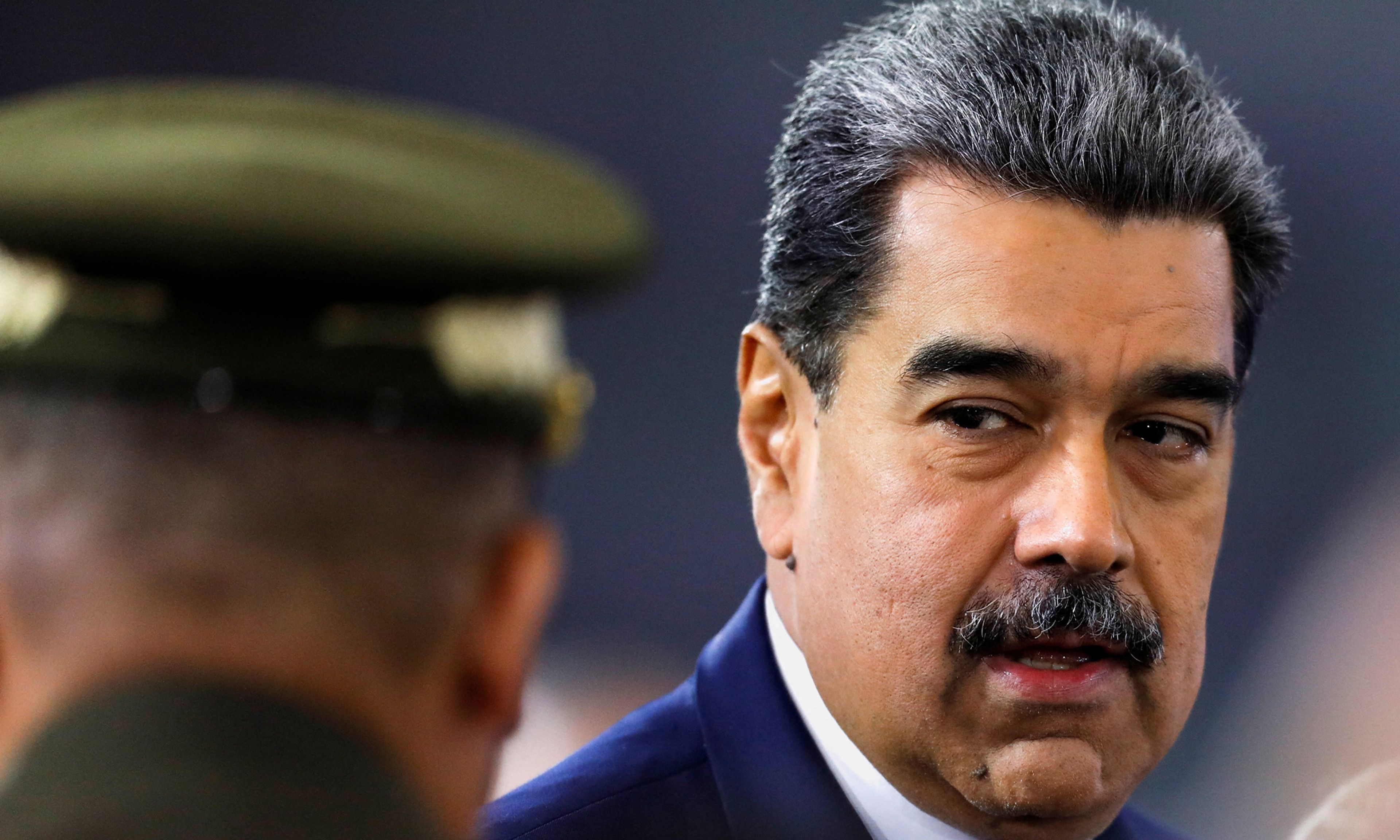
The Trump administration has grasped a strategic reality that eluded the Obama and Biden administrations: the United States faces a direct threat from hostile powers in Latin America that work in concert with our adversaries across Eurasia. As the lone U.S. adversary to have favorable relations and deep strategic partnerships with nearly every single hostile actor, state or non-state, across the world, Venezuela is of great strategic importance.
Although Venezuela receives less cash support from China than it did in the early 2010s, Beijing remains a key financial backer for Nicolás Maduro’s regime. Russia provides military and intelligence support alongside Cuba. At this point, Maduro survives physically because of mercenaries backed by the Russian Wagner Group and Cuban intelligence officers. Caracas also has links with North Korean intelligence.
Under Maduro, Venezuela is key to drug-smuggling in the Western Hemisphere, facilitating the transfer of Colombian cocaine to the U.S. and other international markets. Its role in the drug trade bolsters the pervasive threat of narco-cartel criminality and allows hostile actors to expand their political power in Colombia. Venezuela’s links to cartels also allow it to launder dirty money for Iran and its Middle Eastern proxies.
In actions that may signal a more concerted war to come, the Trump administration has deployed an amphibious task force to the Caribbean, while also deploying more air and naval assets. Since September 2, the U.S. has carried out 20 strikes against suspected drug-running boats in both the Caribbean and Eastern Pacific.
If the Trump administration decides to take the war against Maduro on land, it could quickly surge forces from bases on U.S. territory to threaten or decapitate the Venezuelan narco-regime. This would be a prudent move considering the threat the regime poses to the United States. But the administration is trapped by constraining American strategic paradigms. This is particularly true with regard to Latin America, where the United States has deployed significant military assets to intimidate Maduro’s narco-regime but has yet to commit to the use of force other than drones and limited use of manned aircraft, such as AC-130J gunships.
Washington has a chance to rewrite the strategic map in the Western Hemisphere and cause significant damage to the new Chinese-led axis. It should take this opportunity to eliminate the threat that emanates from Venezuela.
Eliminating that threat requires destroying the Maduro regime’s entire elite cadre, which includes hundreds of military officers and other functionaries. Otherwise, the regime will reconstitute quickly. There are risks to such action, of course. Removing the regime’s infrastructure demands the readiness of an alternative Venezuelan leadership; this could be assembled from among the highly educated Venezuelan exiles living in the U.S., who join Cuban and other Latin American communities to form a core of regional expertise. Such a move would still require significant resources. But failing to take that step would generate a refugee crisis, with knock-on effects across Latin America and potentially more illegal immigration into the United States.
[slideshow slideshow="1895304" /]
American strategic thinking today in part derives from two received ideas about the Cold War: first, that it was fought in Europe and Asia, with the U.S. maintaining deterrence in Europe, working with allies in the Middle East, and fighting small wars in Asia to contain and erode Soviet power; and second, that the U.S. won principally because of long-range macroeconomic factors. Good strategy, in retrospect, was a matter of maintaining essential advantages, like that of capitalism over the Soviet system’s chronic uncompetitiveness.
That conventional wisdom ignores the U.S.-Soviet competition that took place in Africa and the Western Hemisphere. Moscow constantly sought to develop proxies and partners in Latin America from which it could project power, sponsoring leftist guerrilla movements and insurgencies that the Soviets hoped would tie down U.S. resources. There was also a conventional military component: by the 1980s, Soviet submarines and warships could visit Cuban and Nicaraguan ports, to which they delivered large quantities of weapons. Moscow believed that, in a major war, these partners, along with its guerrilla forces and similar allies in Africa, would split U.S. attention for just long enough to allow Warsaw Pact armored formations to smash through West Germany, presenting Washington with the choice between rapid strategic nuclear escalation, a vicious war of attrition with operational nuclear use, and unfavorable negotiations.
A crucial part of the U.S. victory in the Cold War was the securing of Latin America. Ronald Reagan took decisive action in Grenada in 1983, and the U.S. military and intelligence communities demonstrated that they could quickly neutralize the Cuban and Nicaraguan threats. Specific decisions like these, not trend lines, determined the Cold War’s outcome.
Good strategy pits one’s own strengths against an adversary’s weaknesses. The Biden administration extolled alliances as the United States’ asymmetric advantage. But in the Western Hemisphere, the size and proximity of the U.S. are key advantages. China and Russia cannot support Venezuela in a confrontation unless they want to run extraordinary strategic nuclear risks almost immediately -- a reality as true today as it was in the 1960s over Cuba.
Secretary of State Marco Rubio and Deputy Secretary of State Christopher Landau are both deeply familiar with Latin America and understand the threat from Maduro. Neutralizing that threat would not require the enormous logistical operation of Midnight Hammer, carried out last June, when the U.S. shuttled B-2 bombers across the Atlantic and the Mediterranean plus another thousand miles over land to strike nuclear sites in Iran.
The question is whether the Trump administration is truly ready to break with traditional paradigms. Inaction, particularly in Latin America, has been the byword of U.S. policy for many Democratic administrations. The fundamental assumption has been that moving against hostile actors is more work than it is worth. The result has been the creeping collapse of American power, including in our hemisphere. Meanwhile, Trump understood that the awarding of the Nobel Peace Prize to María Corina Machado, in recognition of her two-decade-long effort to bring democracy back to Venezuela, was the right thing to do.
External threats to the U.S. traditionally originated across the seas, from the British burning of the White House in 1814, to attempted Russian colonization of America’s West Coast in the first half of the same century, to the 1917 Zimmermann telegram (threatening German-Mexican military action against the U.S.), to the world wars and the Cold War. Putting out distant fires keeps them away from our shores. When that fails, as President James Monroe noted in 1823, we should look on hostile nations’ meddling “in any portion of this hemisphere as dangerous to our peace and safety.” Given the present Russian and Chinese meddling, Monroe’s admonition is entirely applicable to Venezuela today. In the interests of American security, Trump should act to restore Venezuelan democracy.

About the Author
Seth Cropsey is the president of the Yorktown Institute and the author of Mayday and Seablindness. He served as a naval officer and as deputy undersecretary of the Navy.
Featured Tags
Advertisement
Advertisement
Comments