No, the D.C. Circuit Did Not Give Trump a Victory over Anthropic
Written by Andrew C. McCarthy
Top Justice Department officials ought to stay off social media, for the DOJ’s own good.
Share this story
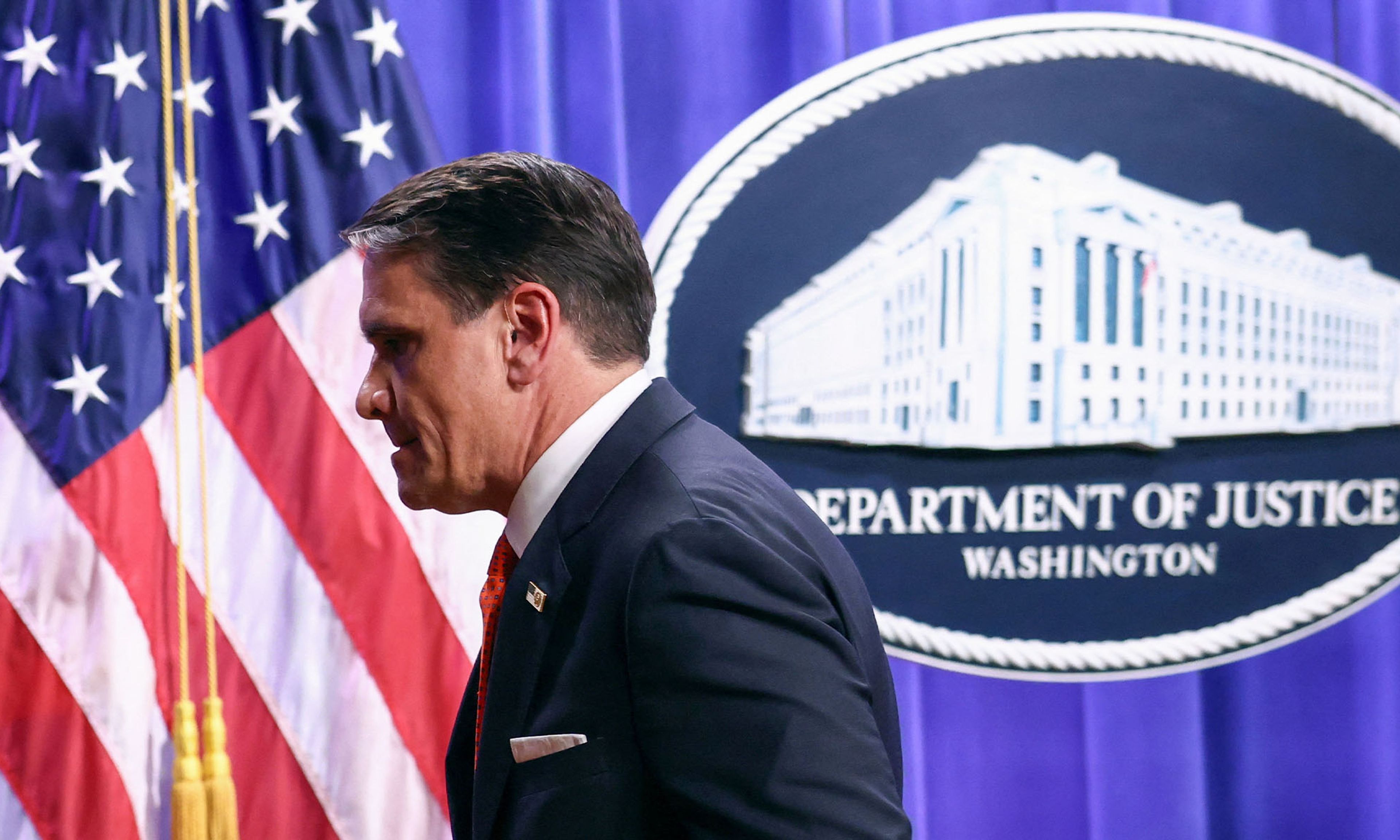
A big reason why the Trump Justice Department has lost the credibility that federal prosecutors traditionally maintain with the federal courts is its penchant for distorting judicial rulings. Case in point: Acting Attorney General Todd Blanche’s crowing on Thursday over a D.C. Circuit action in Anthropic’s lawsuit against the Defense Department.
As is standard DOJ malpractice in the Trump II era, Blanche took to X to opine on a pending case. He claimed that the circuit had issued a “stay allowing the government to designate Anthropic as a supply chain risk,” framing this court action as “a resounding victory for military readiness.”
This was a botched description of the three-judge panel’s action. In reality, the court acknowledged that the Trump administration’s supply chain risk (SCR) designation of Anthropic may well violate statutory law -- not exactly a surprise since another court has already determined that it violated the Constitution. Blanche’s post didn’t even get the “stay” part right: The three-judge panel did not issue a stay in favor of the government. It denied a stay that Anthropic had sought; but instead, the court granted the company’s alternative request for expeditious review of the SCR designation.
As we’ve extensively covered (see here, here, here, and here), Anthropic, a developer of advanced artificial intelligence (AI) models, has sued the government over Defense Secretary Pete Hegseth’s SCR designation. The company has brought two civil actions: a constitutional claim in the federal district court in San Francisco; and a statutory claim under federal procurement law, which routes such actions directly to the D.C. Circuit appellate court, cutting out the district court.
In 2024, Anthropic began providing the government with its main AI tool, Claude, pursuant to a $200 million contract with the Defense Department and U.S. intelligence agencies. Hegseth’s SCR designation of the company occurred last month, after a very public dispute. It was based on two restrictions Anthropic had built into the contract: Claude may not be used to operate weapons systems autonomously (i.e., with no human agent in the decision loop), nor to conduct mass surveillance of Americans.
Hegseth and the Defense Department (which now calls itself the “Department of War”) counter that, regardless of the conditions the government accepted in procuring Anthropic’s AI, it should be able to use Claude for any lawful purpose. In fine demagogic fettle, Trump administration officials add that the restrictions inhibit the American war effort in Iran and thus endanger national security. (As this is written, the war is suspended in a cease-fire agreement that may not hold; since the president has said our forces laid waste to Iran, it’s difficult to understand how Anthropic inhibited them.)
It may or may not be wise for the Defense Department to ditch Claude and transition to a new vendor that provides its AI tools without such strings attached. Quite properly, that is the government’s decision to make -- and, indeed, the DoD has struck an agreement with OpenAI, whose ChatGPT is being phased in as Claude is phased out over the coming months. What is grossly improper, however, is the government’s extortionate and procedurally deficient exploitation of a punitive statutory designation to punish Anthropic for resisting the government’s demands and publicly touting its objections to them.
By placing an SCR designation in federal procurement laws, Congress was targeting foreign entities who could sabotage vital supply chains. I’ve thus contended that applying the SCR label to Anthropic is absurd. In the aforementioned California case, Judge Rita Lin (a Biden appointee) observed that the SCR designation is directed “principally at foreign intelligence agencies, terrorists, and other hostile actors,” and that Hegseth’s designation of a domestic company was unprecedented. Concluding that this ran afoul of the First Amendment, she reasoned: “Nothing in the governing statute supports the Orwellian notion that an American company may be branded a potential adversary and saboteur of the U.S. for expressing disagreement with the government.”
The Trump Justice Department has appealed Judge Lin’s decision to the Ninth Circuit. (This happened last Friday, the day after President Trump fired former Attorney General Pamela Bondi, but the DOJ would have appealed under either Bondi or Blanche.) In the interim, the administration is reportedly complying with Lin’s ruling, allowing government employees and contractors to continue using Claude despite the designation. This further illustrates that the SCR label was plain old bullying; no one seriously believes Anthropic might sabotage American supply chains or threaten national security.
The D.C. Circuit’s ruling is not, as Blanche implied, a judicial endorsement of Hegseth’s action.
The three-judge panel is as good as it gets for the administration: Trump appointees Gregory Katsas and Neomi Rao, joined by Karen Henderson, an appointee of George H. W. Bush. But far from allowing the government to designate Anthropic a supply chain risk, the panel conceded that the designation might violate federal procurement law and potentially saddle the company with financial damages, some of which may not be recoverable.
Nevertheless, the company’s application for a stay (which would have suspended the SCR designation while the case proceeded) faced four challenges. First, even when it appears that a party’s legal rights have been violated, a court will not issue a stay (or similar preliminary relief, such as an injunction) if the party can be compensated for financial harm after a ruling on the merits at the end of the case. Second, although it’s possible that Anthropic will suffer some irreparable harm, the dispute with the government could instead end up being a financial coup for the company: As the court noted, Anthropic’s opposition to the Pentagon’s demand was popular and led to a profitable surge in downloads of Claude. Third, upon doing some preliminary research, the judges noticed that the jurisprudence on the relevant procurement statutes is sparse; that renders it more difficult than usual to gauge whether a party is likely to win on the merits (always a major question in stay cases).
Fourth and finally, because national security is implicated, the court must tread carefully. For what it’s worth, I am not persuaded by the panel’s suggestion that a ruling in the company’s favor could require the Defense Department “to prolong its use of Anthropic’s AI technology, whether indirectly or through contractors.” The main issue in the case is whether the government can validly designate Anthropic as an SCR, not whether the court can force the government to use Claude -- the latter, if it were the case, would indeed be “a substantial judicial imposition on military operations,” as the court fears. All that said, the judges are right to proceed cautiously. As the per curiam order puts it, “Of course, we do not lightly override the [Defense] Department’s judgments on matters involving national security.”
Those considerations counseled against granting the stay that Anthropic sought. So did another technical concern that the court sidestepped: The DOJ forcefully argued that the court lacked jurisdiction to issue a stay because the governing statute (Section 1327(b) of Title 41, U.S. Code) does not expressly grant it such authority. (I suspect that is because Congress did not anticipate that the executive branch would use the designation to stigmatize a domestic company.)
Obviously, Anthropic realized that its application for a stay was not on the firmest of ground. Hence, it didn’t limit itself to seeking that relief; it asked, in the alternative, for expedited review. And the panel unanimously granted that request. Consequently, briefs are due in the next three weeks, and the panel will hear argument on May 19. That’s lightning speed as these things go.
If the new acting attorney general thinks that’s a big win, one shudders at the thought of an out and out loss. In any event, to suggest that the D.C. Circuit has sustained the Trump administration’s SCR designation of Anthropic is flatly wrong.
Not that anyone cares what I think, but top Justice Department officials -- especially the top Justice Department official -- ought to stay off social media, for the DOJ’s own good, if that’s any longer a consideration. If today’s DOJ can’t resist the president’s insistence that it become a political cog in the White House press machine, despite longstanding and prudential DOJ guidance to the contrary, it should bear this in mind: While the courts will never approve of prosecutorial grandstanding, they will punish prosecutorial distortions.

About the Author
Andrew C. McCarthy is a senior fellow at National Review Institute, an NR contributing editor, and author of Ball of Collusion: The Plot to Rig an Election and Destroy a Presidency.
Featured Tags
Advertisement
Advertisement
Comments