Let’s Make Space Nuclear Again
Written by Andrew Follett
‘The moon is not the endpoint. It is the proving ground for what comes next.’
Share this story
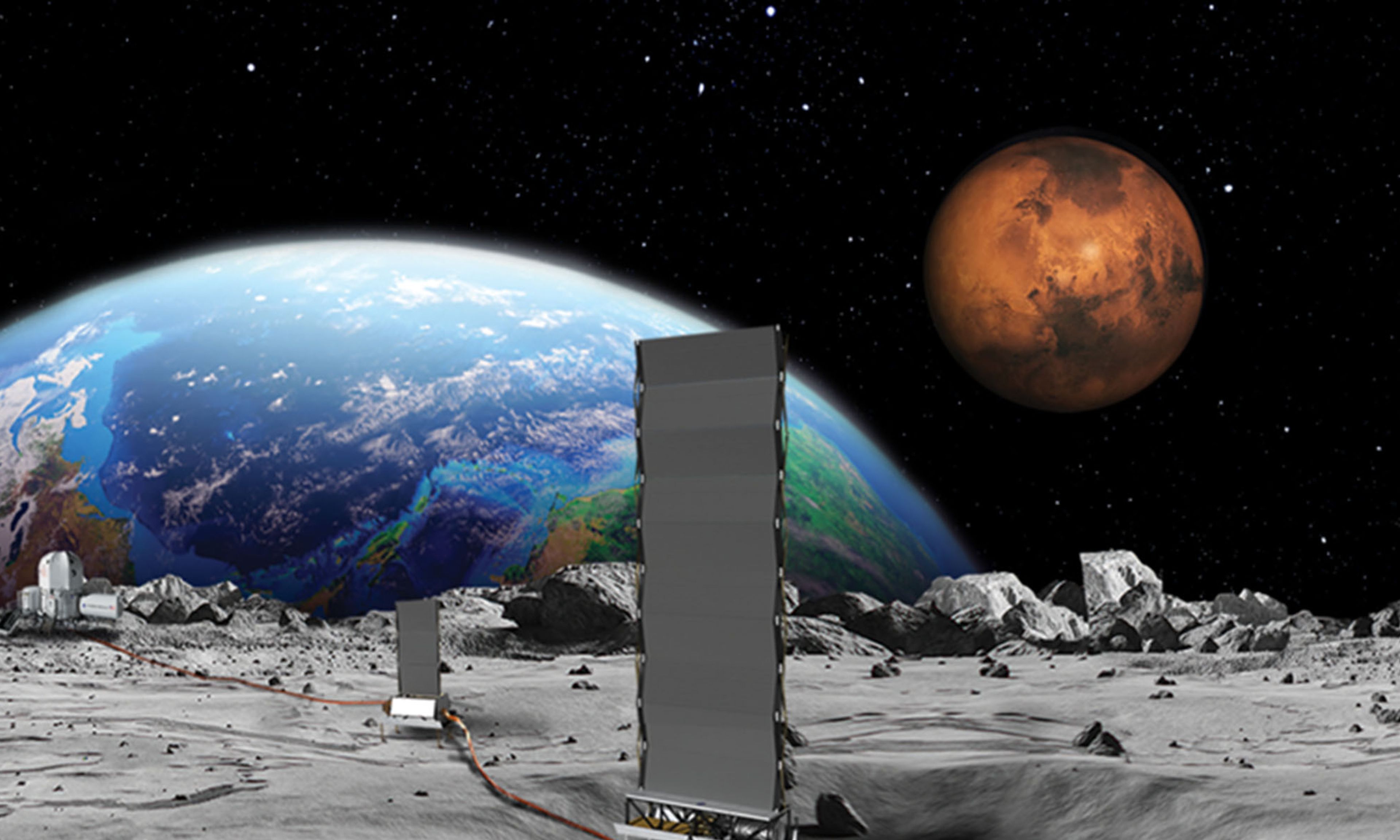
America will harness nuclear power in space again by 2031, thanks to competition and the private sector, according to a new strategy published by the White House this past week.
The Trump administration intends to establish a nuclear reactor on the moon’s surface within the next five years. This is welcome news. Using nuclear power on the final frontier will help secure U.S. leadership in space.
“Nuclear power in space will give us the sustained electricity, heating and propulsion essential to a permanent robotic and eventually human presence on the moon, on Mars and beyond,” Michael Kratsios, director of the White House Office of Science & Technology Policy, told Breaking Defense. “Executing on the President’s National Space Strategy will require a whole of government approach, as well as the drive and ingenuity of America’s private space industry.”
Traditional space power sources such as solar arrays and batteries work best in low-earth orbit and for short lunar missions, but they face hard limits on deep-space trajectories — where sunlight is weak — and in the permanently shadowed lunar craters most suitable for bases.
Nuclear reactors, however, deliver reliable, high-density energy that can power life-support systems, science instruments, propellant production, and even, potentially, propulsion on demand. If we are to establish sustained operations on the moon, nuclear power will be essential.
In 1965, NASA began using the System for Nuclear Auxiliary Power (SNAP) reactor, the first and only nuclear reactor launched into space by the U.S. The reactor, no longer functioning, remains in orbit today, and its radioactive inventory is expected to decay safely over millennia.
“The moon is not the endpoint. It is the proving ground for what comes next,” Jeff Terry, vice provost for research at the Illinois Institute of Technology and an expert on energy systems, told National Review. “The country that learns how to generate dependable power off earth will be in a much stronger position not only on the lunar surface, but also for missions farther out into space. So in that sense, nuclear power is not just a technical option. It is a strategic necessity if we are serious about the moon and beyond.”
The Trump administration’s new strategy recognizes that, without nuclear systems, America risks ceding the moon and Mars to competitors like China, which are already investing in space-based nuclear technology.
Under Trump’s plan, NASA and the Department of War will conduct a series of design competitions and “work with private sector innovators” to develop low- to mid-power space reactors in orbit and on the lunar surface. High-power reactors will then be deployed in the 2030s.
The White House strategy explicitly lists several space policy reforms that I have previously suggested to encourage private-sector development. These include fixed-price contracts, a milestone prize system, and the establishment of government use rights. By directing NASA and the DOW to run competing vendor programs and share technology, the initiative revives the risk-tolerant, innovation-first mindset that powered the Apollo era and modern space commerce. Treating private industry as a partner rather than a regulated afterthought will keep schedules aggressive and costs under control.
This combination of government urgency and commercial drive has historically allowed the United States to outpace its rivals in high-stakes domains.
The administration’s strategy states that nuclear thermal propulsion could be an “option for future crewed missions to Mars.” This may sound like science fiction, but the U.S. has been demonstrating nuclear propulsion since 1965.
Nuclear thermal propulsion systems offer “much higher specific impulse,” Terry said. “In practical terms, that means you can get more mission capability out of less propellant. And once you start thinking seriously about the moon, Mars, and beyond, that becomes a major advantage.”
In the 1960s and early 1970s, NASA and the Atomic Energy Commission developed and successfully ground-tested engines that achieved specific impulses of 900 seconds, roughly twice that of the best chemical rockets today. This increase in efficiency fundamentally changes what is possible in space flight by delivering chemical-rocket levels of thrust while using far less propellant mass for the same change in velocity.
Conventional chemical rockets are limited by the energy stored in their fuel-oxidizer bonds. Nuclear thermal propulsion, meanwhile, harnesses the vastly greater energy density of nuclear fission. A nuclear-propelled rocket could send substantially heavier payloads to the moon, Mars, or beyond using the same launch vehicle . . . or reach destinations faster with the same payload. “Nuclear thermal propulsion,” Terry said, “opens the door to a very different scale of exploration.”
For crewed Mars missions, this could slash one-way transit times from roughly nine months to four, dramatically cutting astronauts’ exposure to cosmic radiation, microgravity-induced health risks, and the psychological strain of long-duration flight.
“The United States was demonstrating the fundamentals of nuclear rocketry decades ago,” Terry said. “The question now is whether we are willing to do so again.”
Reviving these sorts of nuclear programs is strategically vital because other countries are already competing with the U.S. Russia crashed its Luna 25 spacecraft into the Moon in 2023, and China plans to land astronauts there by 2030.
“Make Space Nuclear Again” is not a nostalgic slogan; it is the practical recognition that fission reactors will allow us to move beyond flags-and-footprints moon visits and establish permanent productive outposts. A nuclear space program will turn visionary ideas such as crewed Mars landings, cislunar logistics, and outer-planet probes into executable programs. It is the difference between winning the 21st-century space race and merely watching America’s adversaries blast off.

About the Author
Andrew Follett conducts research analysis for a nonprofit in the Washington, D.C., area. He previously worked as a space and science reporter for the Daily Caller News Foundation.
Featured Tags
Advertisement
Advertisement
Comments