Share this story
The scene? Mass destruction and pandemonium, complete with crumbled cake, half-glazed cake cubes, and white-chocolate frosting dripping from the counters. The location? My kitchen. The time? 10 p.m. on a Wednesday.
When they say “the internet is forever,” I take it seriously — which is why you’ll be getting no pictures of my latest baking disaster (please admire the pictures of my successes, however). I shall, however, describe it in all its crumbling glory.
It started with a birthday request from a friend. She wanted to host a high tea for her 27th birthday and asked if I’d make the food. Happy to oblige and excited for the opportunity, I began researching almost immediately. I’ve read enough British literature to guess that “high tea” was probably not your everyday cup-and-saucer affair, but I didn’t know much more than that.
Enter Pinterest. This site has been my “social media” of choice for years now, and while handy hints and ideas found there deserve some outside research to prove their reliability (and sometimes safety), it’s been a lovely tool for outfit, recipe, and decorating inspiration. It’s also a wonderful resource when you’re planning a party. After some perusing and note-taking, I’d discovered a few interesting facts, the first of which was that a “high tea” meant more of a sit-down meal. Since the birthday girl wanted to watch a movie during the party, ours would be a hybrid affair. Perhaps most amusing was learning where, exactly, “tea time” originated, and I’m deeply indebted to the 7th Duchess of Bedford for taking the lead and insisting that the hours between lunch and dinner are too long to go without a reviving snack.
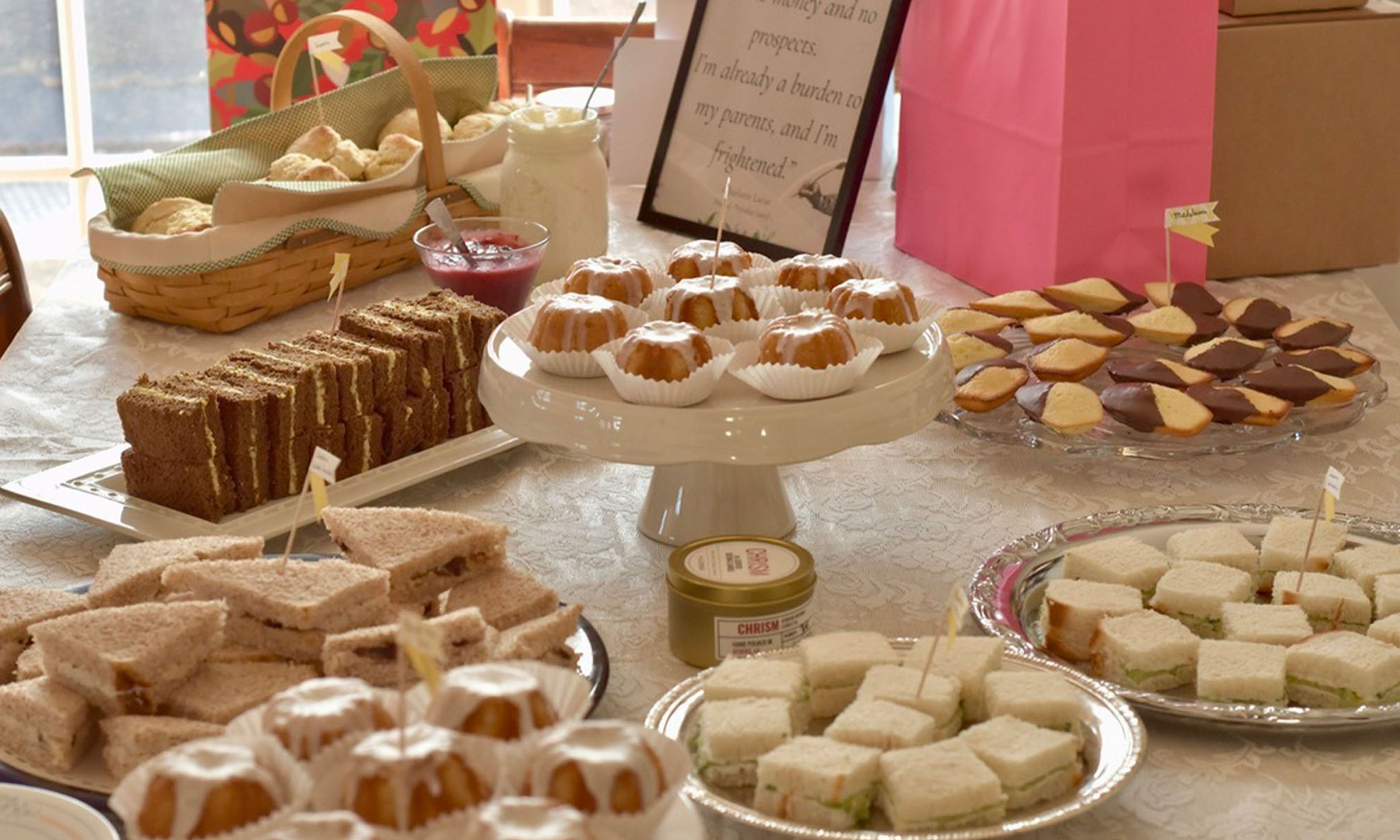
Many sites, and the above presentation in particular, gave plenty of helpful information and guidance about hosting such an event, but my true task would be the food. I could already envision a doable menu:
Savory:
◦ Cucumber sandwiches
◦ Egg salad sandwiches
◦ Chicken salad sandwiches
Bread:
◦ Scones + clotted cream
Sweet:
◦ Macaroons or petit fours
◦ Mini Victoria sponges
◦ Lemon drizzle cake
Luckily for me, I’d made some version of everything on this list before, except petit fours and clotted cream. True clotted cream takes hours, which I’ll eventually be willing to spend, but for this affair, I went with a “fake” option that worked beautifully. Petit fours, however, were another story. There are, as I learned, three types of petit fours — glacé (“glazed”), salé (“salted”), and sec (“dry’). I ignored my better judgement and decided to attempt the glacé variety.
Unfortunately, this endeavor was doomed from the beginning when I decided to use a gluten-free recipe for the test run. The idea was to test these and give them to the class I teach once a week. One of my students was celebrating her birthday, some of my students are gluten-free, and I needed a gluten-free dessert option for the party — all points I thought would make for the perfect excuse to make petit fours.
Not so.
While I generally highly recommend the recipes from King Arthur Baking Company, I won’t ever use their gluten-free vanilla-cake recipe again. It’s an oil-based recipe, which, while it made for a moist cake, was almost too oily. Also, in order to coat the mini cakes in icing, you need to keep the pieces frozen. Given my limited freezer space, I was unable to do so, and ended up with crumbs and drowned chunks of cake in the icing. Honestly, the icing itself was a success, but this was small consolation.
So at 10 p.m., I finally admitted that this attempt at petit-four creation was completely unsustainable and that I needed to sleep. For my student’s birthday, I reverted to that beloved staple: chocolate-frosted cupcakes. They turned out gloriously, and our little party the next day went off well.
It was now back, partially, to the drawing board for the formal tea menu. The revised list?
Savory:
◦ Cucumber sandwiches
◦ Egg salad sandwiches
◦ Chicken salad sandwiches
Bread:
◦ Scones + clotted cream + jam
Sweet:
◦ Mini cream puffs
◦ Mini lemon drizzle cakes (gluten-free)
◦ Chocolate-dipped madeleines
Cucumber sandwiches are strangely popular at these events, and I’m sure it would’ve been simpler to make only those, but I had learned from my handy guide that high teas usually involve multiple types of sandwiches.
Chicken salad was easy: Emily Stimpson Chapman, in her recent cookbook, Around the Catholic Table, has hands-down the best recipe I’ve ever used, mainly because it includes dried cherries, which are far superior (in taste and, alas, cost) to dried cranberries. I also used canned chicken, which is brilliant if you’re pressed for time.
For the egg salad, the recipe I’d originally planned called for chives, but when I bought them from Kroger, they were slimy and unusable. Not having time to go back, I threw in the towel and made it just like my mom, with mayo, mustard, salt, and pepper, all tossed in the food processor. (Though I don’t think my mom ever ran her food processor in the bathroom so she wouldn’t wake up her roommate.)
I’d intended to do most of this prep, including making the scones and clotted cream, early on the day before the party, but duty called and family obligations went late into the evening. Snatching a few hours between work and my siblings’ talent show, I managed to prep sandwich fillings and make madeleines (which my thoughtful roommate then dipped in chocolate for me). Also, I had the good sense to acquire mini cream puffs from the grocery-store gods, which saved me immense amounts of time and a headache.
The delightful part of all this came in the hours just before the party, when we arrived at my friend’s apartment with all the consumables ready for assembly. Her mom and niece were in town for the event, and we had a delightful time creating sandwiches, balancing the trays in the fridge, sneaking cream puffs, and arranging the table.
Despite my petit-four fail, I (and more important, the birthday girl) was pleased with the general food outcome, in both taste and presentation. I’ve helped with food for many a party now, and, while they will always come with complications and mishaps, sharing joys and laughing at late-night disasters with others is always reward enough.
About the Author
Sarah Schutte is the podcast manager for National Review and an associate editor for National Review magazine. Originally from Dayton, Ohio, she is a children's literature aficionado and Mendelssohn 4 enthusiast.
Featured Tags
Advertisement
Advertisement
Comments